ঢাকারবিবার , ৯ অগাস্ট ২০২৬
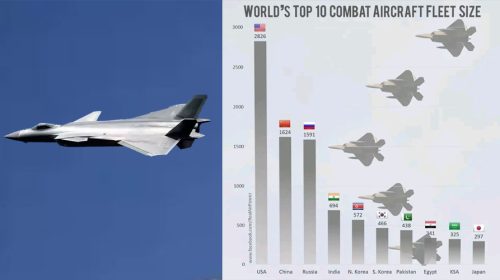
In the modern era of geopolitical uncertainty, air power remains a fundamental pillar of national defense and global influence. Combat aircraft, including fighters, multirole jets, and interceptors, are among the most decisive elements of military capability. These aircraft not only secure national airspace but also project power beyond borders, deter aggression, and provide critical support in both conventional warfare and counterterrorism operations. As of the latest available data, ten nations dominate the skies with the largest operational fleets of combat aircraft, each maintaining a force shaped by its strategic needs, industrial capacity, and defense priorities.
The United States stands as the undisputed leader in combat aviation. With a fleet of approximately 2,826 combat aircraft, the United States Air Force, Navy, and Marine Corps collectively maintain the largest and most technologically advanced aerial fleet in the world. This fleet includes a significant number of fifth-generation stealth fighters such as the F-22 Raptor and F-35 Lightning II, along with numerous fourth-generation multirole fighters like the F-15 Eagle, F-16 Fighting Falcon, and carrier-based F/A-18 Hornets. The dominance of the United States in this domain is underpinned by a robust defense budget, world-leading aerospace industries, and global military commitments that necessitate rapid deployment capabilities. American air power is strategically dispersed across domestic bases and overseas installations, ensuring presence and rapid response potential across the globe.
China occupies the second position with a combat fleet of approximately 1,624 aircraft. Over the past two decades, China has undertaken a massive modernization drive of the People’s Liberation Army Air Force (PLAAF) and the aviation wing of the People’s Liberation Army Navy (PLAN). Indigenous aircraft development has been a cornerstone of China’s military strategy, culminating in advanced fighters like the J-20 stealth fighter and the multirole J-10 and J-11 platforms. Chinese aerospace companies such as AVIC and Chengdu Aircraft Corporation have rapidly progressed, supported by significant government investment and an aggressive technology acquisition strategy. China’s air power reflects its growing regional and global aspirations, with increasing attention on defending its territorial claims in the South China Sea, Taiwan Strait, and the wider Indo-Pacific region.
Russia, with a fleet of approximately 1,591 combat aircraft, retains its status as a formidable air power despite economic constraints and the challenges posed by international sanctions. The Russian Aerospace Forces operate a blend of Soviet-era legacy platforms and modernized aircraft. Iconic fourth-generation jets such as the Su-27, Su-30, Su-35, and MiG-29 still form the backbone of Russia’s fleet, supplemented by newer models like the Su-57, Russia’s first operational fifth-generation stealth fighter. Russia’s doctrine emphasizes multi-role capabilities, air superiority, and deep strike potential, a reflection of its extensive land borders and strategic military engagements in regions such as Eastern Europe, Central Asia, and the Middle East. The country’s participation in the Syrian conflict showcased the operational capabilities of its air force and the performance of several aircraft under combat conditions.
India ranks fourth in the global tally with approximately 694 combat aircraft. The Indian Air Force (IAF) and Indian Navy operate a diverse fleet comprising Russian-origin platforms like the Su-30MKI and MiG-29, French-built Rafale multirole fighters, and indigenous jets such as the HAL Tejas. The strategic environment surrounding India, particularly the long-standing tensions with Pakistan and the rising military assertiveness of China, drives the country’s emphasis on air combat readiness. The IAF has focused on enhancing interoperability, precision strike capability, and network-centric warfare. India’s air force is unique in its tri-national aircraft inventory, relying on Russian, Western, and domestically produced systems. Additionally, India continues to invest in advanced technologies and new acquisition programs aimed at replacing aging fleets and bolstering its position as a major air power in South Asia.
North Korea, surprisingly, holds the fifth-largest fleet of combat aircraft, with around 572 jets. However, the qualitative dimension of this fleet presents a stark contrast with other top-tier powers. North Korea’s air force consists primarily of outdated Soviet-era aircraft, including MiG-21s, MiG-23s, and a limited number of MiG-29s. These platforms, many of which date back to the 1960s and 1970s, suffer from limitations in avionics, weapons systems, and airworthiness. Despite these shortcomings, the large fleet reflects the country’s doctrine of military deterrence and internal defense, as well as its policy of maintaining high levels of readiness against perceived external threats, particularly from South Korea and the United States. The emphasis is more on numbers and psychological deterrence rather than modern technological competitiveness.
South Korea follows with a fleet of 466 combat aircraft, reflecting its advanced technological infrastructure and persistent security threats from its northern neighbor. The Republic of Korea Air Force operates modern fighters such as the F-15K Slam Eagle, F-16 Fighting Falcon, and the recently acquired F-35A stealth fighters. South Korea also maintains a growing indigenous aerospace industry, exemplified by the development of the KF-21 Boramae fighter jet, a fourth-plus generation platform that signifies a significant leap in domestic production capability. Given the Korean Peninsula’s volatility, South Korea maintains a high state of readiness, emphasizing rapid response, precision strike, and integrated air defense. The interoperability with U.S. forces stationed in South Korea further enhances its strategic deterrence.
Pakistan ranks seventh globally with around 438 combat aircraft. The Pakistan Air Force (PAF) is structured around multirole platforms such as the F-16, JF-17 Thunder (developed jointly with China), and legacy aircraft including the Mirage III and Mirage V. Pakistan’s focus on maintaining aerial parity with India has shaped its procurement and modernization strategy. While limited by a smaller defense budget, the PAF compensates with high training standards and close cooperation with allies like China and Turkey. The JF-17 program has been particularly critical, offering a cost-effective solution for replacing aging aircraft and improving operational flexibility. Pakistan’s strategic priorities center on maintaining deterrence, ensuring rapid mobilization, and adapting to asymmetric threats, particularly along its eastern and western borders.
Egypt holds the eighth position with a combat aircraft fleet numbering approximately 341. As the largest air power in the Arab world, the Egyptian Air Force plays a central role in regional security dynamics, particularly in the Middle East and North Africa. Egypt operates a diverse mix of American, Russian, and French aircraft, including F-16 Fighting Falcons, MiG-29s, and Rafales. This diverse procurement strategy reflects Egypt’s diplomatic balancing between Western and Eastern partners. The Egyptian Air Force has undergone significant modernization in recent years, with a focus on improving strike range, interoperability, and precision capabilities. Egypt’s strategic interests include counterterrorism operations in the Sinai Peninsula, the security of the Suez Canal, and regional power projection in cooperation with Gulf allies.
Saudi Arabia, with approximately 325 combat aircraft, maintains one of the most advanced air fleets in the Middle East. The Royal Saudi Air Force operates American-made F-15 variants, European Typhoons, and other high-performance multirole jets. The Kingdom’s air power has been instrumental in coalition operations, particularly in the ongoing conflict in Yemen, and serves as a deterrent against regional rivals like Iran. The Saudi defense strategy emphasizes advanced technology, long-range strike capability, and aerial dominance. Backed by substantial financial resources, Saudi Arabia continues to invest heavily in aircraft procurement, pilot training, and maintenance infrastructure. Additionally, the country has been promoting local defense manufacturing under its Vision 2030 initiative to reduce dependency on foreign suppliers.
Japan rounds out the top ten with a fleet of 297 combat aircraft. As a technologically advanced nation with a constitutionally constrained military doctrine, Japan’s air power is built primarily around defense and deterrence. The Japan Air Self-Defense Force (JASDF) operates advanced aircraft such as the F-15J, F-2 (a Japanese variant of the F-16), and a growing fleet of F-35A stealth fighters. With regional tensions rising, particularly due to Chinese military activity around the Senkaku Islands and North Korean missile tests, Japan has expanded its defense posture while maintaining a defensive policy under its pacifist constitution. The country’s air strategy focuses on technological superiority, airspace control, and integration with U.S. forces under the Japan-U.S. security alliance.
In conclusion, the composition and scale of combat aircraft fleets around the world reflect a combination of historical context, strategic threat perceptions, and technological aspirations. While the United States remains far ahead in sheer numbers and capability, countries like China and Russia continue to close the gap with large-scale production and modernization efforts. Regional powers such as India, South Korea, and Pakistan tailor their air forces according to specific geopolitical challenges, often blending foreign acquisitions with domestic innovations. Meanwhile, nations like Egypt, Saudi Arabia, and Japan emphasize a mix of modernization, regional influence, and strategic alliances. Collectively, these ten nations underscore the continuing centrality of air power in global military planning and the high stakes involved in dominating the skies.