ঢাকাশনিবার , ১৯ সেপ্টেম্বর ২০২৬
Sri Lanka’s experience in imposing specific taxes on tobacco products could serve as a model for Bangladesh, as the country’s specific tax approach has helped raise revenue while also delivering positive results for public health protection. Although Bangladesh currently applies an 83 percent tax rate on cigarettes — the highest in South Asia — compared with Sri Lanka’s 68 percent, cigarettes remain far more accessible in Bangladesh, roughly seven times more so than in Sri Lanka. As a result, in order to protect public health while boosting government revenue, the tobacco tax structure of neighbouring Sri Lanka is worth following.
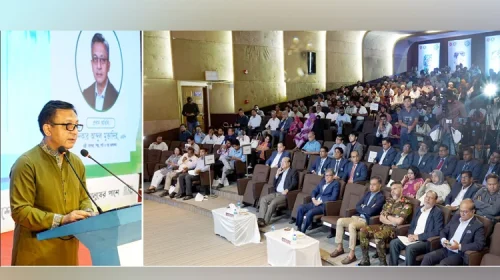
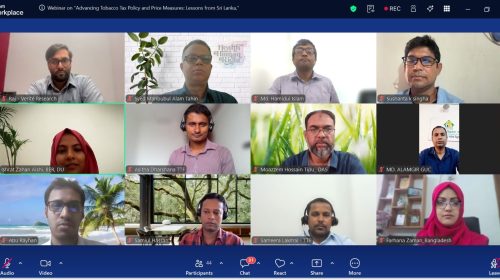
Tobacco tax experts from Sri Lanka and Bangladesh made these remarks this morning, Tuesday (15 August 2026), at a webinar titled “Advancing Tobacco Tax Policy and Price Measures: Lessons from Sri Lanka.” The webinar was jointly organised by the Bureau of Economic Research (BER), University of Dhaka; the Bangladesh Network for Tobacco Tax Policy (BNTTP); and the Take Turn Foundation, Sri Lanka.
Chaired by Prof. Dr. Nasiruddin Ahmed, former Chairman of the National Board of Revenue (NBR), the webinar featured keynote presentations by Raj Prabu Rajakulendran, Lead Economist at Verité Research, Sri Lanka, and Asitha Dharshana Fonseka, Director of the Take Turn Foundation, Sri Lanka. Panelists included Dr. Nishan de Mel, Executive Director of Verité Research, Sri Lanka; Sameera Lakmal, Director–Programme at the Take Turn Foundation, Sri Lanka; and Advocate Syed Mahbubul Alam Tahin, Senior Technical Advisor, Bangladesh, at Vital Strategies. The session was moderated by Ms. Ishrat Zahan Aishi, Research Associate at BER.
Speaking at the webinar, Prof. Dr. Nasiruddin Ahmed said the tobacco sector plays a crucial role in Bangladesh’s tax system, contributing nearly 10 percent of total revenue. He noted, however, that many of the problems in the country’s tax structure are structural in nature, including the four tiers for cigarettes, two tiers for bidis, and flaws in the taxation of smokeless tobacco products. He added that the ad valorem tax system is highly flawed and tax administration remains weak, and that mutual experience-sharing with Sri Lanka would help Bangladesh address these structural and administrative barriers.
Raj Prabu Rajakulendran said that in Sri Lanka, 70 percent of the tax the government levies on cigarettes to raise revenue is a specific tax based on cigarette length, with VAT applied separately on top, allowing the government to directly control retail prices. By contrast, he said, Bangladesh’s tax structure is entirely ad valorem, which effectively leaves the power to set the base price in the hands of manufacturers. He argued that shifting from an ad valorem system to specific taxation would therefore be a positive step for boosting Bangladesh’s revenue as well.
He further said that specific taxes need to be adjusted regularly to keep pace with income growth — either automatically, as in Australia, or through close monitoring by civil society and research organisations. He also noted that raising taxes does not necessarily reduce revenue: when Sri Lanka introduced specific taxation in 2016, the tax on cigarettes rose by nearly 60 percent, while the government’s tax revenue increased by around 50 percent.
Dr. Nishan de Mel said that whatever the current price level in Bangladesh, the goal should be to raise it at least sixfold — a target that cannot be achieved if companies are left to set the price themselves. He said the specific tax must be fixed in monetary terms, suggesting, for example, 15 taka per cigarette, with the remainder continuing under the existing price-based tax system. The most important consideration, he stressed, is ensuring that no other tax mechanism is withdrawn at the time specific taxation is introduced. Tobacco companies, he warned, often propose replacing existing ad valorem duties with a specific tax; instead, all other taxes should remain unchanged, with the specific tax added on top as an additional levy — an approach that would yield positive results for both public health and revenue.
Asitha Dharshana Fonseka said that raising tobacco taxes could help the country avoid proposed tax increases on electricity and mobile data for ordinary citizens, thereby relieving the general public of additional burdens elsewhere. At the same time, he said, the additional revenue could be channelled into public health spending.
Sameera Lakmal said that in Sri Lanka, university economics departments have at times ended up amplifying the tobacco industry’s talking points. He cautioned that Bangladesh must remain vigilant against tobacco industry interference in tax policy and take effective steps to advance both public health and revenue objectives.
Advocate Syed Mahbubul Alam Tahin said Sri Lanka’s experience with specific taxation holds important lessons for Bangladesh, particularly in how Sri Lanka built its evidence base and presented it to policymakers — an approach Bangladesh should study closely. He expressed hope that Bangladesh, too, would introduce specific taxation alongside the existing ad valorem system on tobacco products to advance public health and boost revenue.
In his closing remarks, BER Project Director Hamidul Islam said the goal is a tobacco-free Bangladesh by 2040. He acknowledged that this is an extremely difficult target but one that must be achieved, adding that working together and applying the lessons learned from Sri Lanka’s experience would make the effort easier.
The webinar was attended by around 70 representatives from various anti-tobacco organisations across the country, including public health experts, economists, tobacco control specialists, researchers and journalists from Bangladesh and Sri Lanka.