ঢাকাশনিবার , ১৯ সেপ্টেম্বর ২০২৬
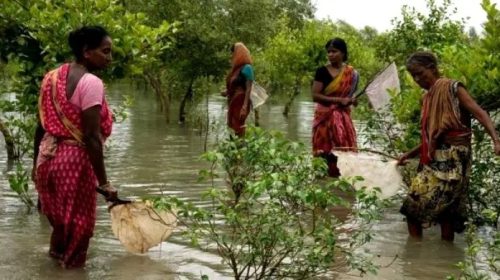
The southwestern coastal sky echoes with the roaring sound of saline winds. Surrounded by vast mangrove forests and the turbulent waves of the Kholpetua and Kopotaksha rivers, an ancient community—the Munda—has been living for centuries on the very edge of the majestic Sundarbans.
While debates on indigenous rights and culture take place globally, the Munda community in the coastal embankments of Shyamnagar and Assasuni in Satkhira is waging a fierce struggle for survival within a ring of saltwater.
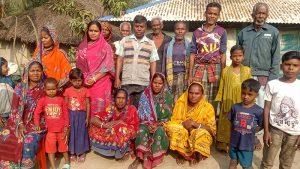
Historical records show that about two centuries ago, during the British colonial period, the Munda people were brought from the Chota Nagpur Plateau of Jharkhand, India, to clear the forests of the Sundarbans. Although these Mundas were the primary architects behind clearing the jungle and establishing human settlements, history has played a cruel irony: today, they remain marginalized as outsiders on their own land.
Currently, about 5,000 Munda people live in several villages across Shyamnagar’s Burigoalini, Munsiganj, Gabura, and Padmapukur unions, as well as parts of Assasuni. Natural disasters have become an inescapable part of their lives. Cyclones like Aila, Amphan, Yaas, and recent storms strike this Sundarbans-adjacent community first and hardest.
A severe crisis of fresh drinking water has made their lives even more miserable. Women have to walk several miles or row boats just to collect drinking water. Soil salinity has made traditional cultivation of vegetables and rice nearly impossible.
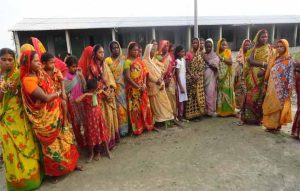
Rghunath Munda (70), an elderly resident of Burigoalini village, said, `When storms hit, everyone goes to cyclone shelters, but if our mud houses and tin roofs are destroyed, we lack the resources to rebuild them. River erosion swept away our ancestral homesteads long ago, and the surrounding water is entirely saline. We can manage without food, but walking miles just for a drop of drinking water at the end of the day is exhausting. Our ancestors cleared the forests to make a home for people, and now we are perishing due to a shortage of water.’
On-site observations reveal that once dependent on foraging and forest resources, the Munda people now survive primarily as daily wage laborers—building or repairing shrimp enclosure embankments. Some secure permits to enter the forest to collect honey, catch crabs, and fish. Due to a lack of proper education and social discrimination, their access to the mainstream economy remains extremely limited.
The Munda community has its own language, known as `Sadri’ or `Mundari’. However, due to the lack of a written alphabet and the influence of modern education, the younger generation is steadily losing this mother tongue. Despite countless hardships, they still preserve their traditional festivals like `Karam Puja’ and `Sohrai Puja’. Dancing in circles hand-in-hand to the beats of the madol (drum) provides a rare slice of joy amidst endless suffering.
Rina Munda (19), a college student at Shyamnagar Government College, said, `We have our own language and songs, but there are no books in our native tongue in schools or society. We learn some words by listening to elders, but will the next generation remember it? We want to enter the mainstream and pursue careers, but not at the cost of losing our identity. If the government arranged primary education in our language, our culture would survive.’
Recently, some non-governmental organizations and government social safety net programs have attempted to bring Munda families under welfare coverage. A small number of Munda children are now attending school, with a few even reaching colleges and universities. However, this is negligible compared to the actual demand.
The Munda community has placed several key demands before the government, including: granting legal ownership of land, introducing primary education in the Mundari language, establishing permanent freshwater treatment plants across the coastal region, and providing special quotas, scholarships, and financial assistance to prevent school dropouts.
Krishna Pada Munda, Executive Director of ‘Sundarban Indigenous Munda Organization (SAMS)’, a local body working for indigenous rights, stated, `Marginalized groups like the Munda, Mahato, and Rajbangshi have lived along the Sundarbans coast for generations, but many remain left behind. They suffer the most during natural disasters like Aila, Amphan, and Yaas. Without active state and societal intervention to secure their land rights, sustainable freshwater solutions, and cultural preservation, this ancient heritage and community will become impossible to sustain.’