
ঢাকামঙ্গলবার , ২৮ জুলাই ২০২৬
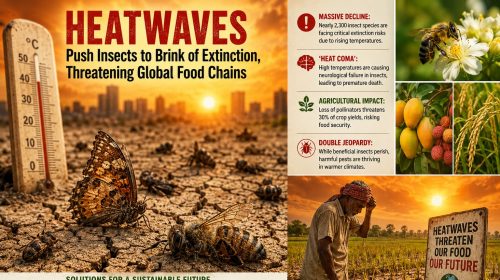
Hasan Mahmud: The world’s most diverse ecosystems, including the Amazon, are facing a severe existential crisis. A study published in the international scientific journal Nature this past March (March 4, 2026) has created a stir globally. Scientists have warned that about 2,300 species of insects are unable to adapt to the rising global temperature, a situation that could completely collapse the human food chain.
Researchers from the University of Würzburg and the University of Bremen in Germany conducted this intensive study on approximately 2,300 species (over 8,000 samples) of insects across the plains and mountainous regions of the Amazon and Kenya.
Lead researcher Dr. Philip Janzen of the University of Würzburg states, “We usually think that as temperatures rise, animals will move to cooler places. But insects in the plains of the Amazon or Kenya have no high or cool ground to escape to. Their path is blocked. If these insects cannot change their ‘protein architecture’ rapidly, they will go extinct right before our eyes.”
Studies show that these tiny creatures are losing the physical ability to adapt to rapidly rising global temperatures. The key findings of the research are summarized below:
Genetic Limitations: Scientists have proven that an insect’s ability to tolerate high temperatures depends on its protein structure (protein architecture). It takes thousands of years for this structure to change. Consequently, they are unable to adapt to the current rapid pace of climate change.
Heat Coma: Research reveals that when temperatures exceed a certain limit, insects lose neurological and muscular control. Scientists call this state ‘heat coma.’ In this condition, insects cannot move or feed, eventually leading them to death.
Lowland Risk: Insects in low-lying areas like the Amazon have nowhere to escape. As a result, nearly 50 percent of insect species in these regions are at risk of extinction by the year 2100.
key-point:
Massive Decline: Nearly 2,300 insect species are facing critical extinction risks due to rising temperatures.
‘Heat Coma’: High temperatures are causing neurological failure in insects, leading to premature death.
Agricultural Impact: Loss of pollinators threatens 30% of crop yields, risking food security.
Double Jeopardy: While beneficial insects perish, harmful pests are thriving in warmer climates.
The Context of Bangladesh:
For an agricultural, low-lying country like Bangladesh, this news is a terrifying warning. The beneficial insects and bees essential for the country’s mango, lychee, and paddy cultivation are today facing an existential crisis due to intense heatwaves. The extinction of these invisible creatures threatens not just biodiversity, but the very foundation of our food security. Experts believe that the methane plumes detected from space, which are raising the temperature, are pushing our fields toward a silent famine. According to agricultural and environmental experts, the impact on Bangladesh will be far-reaching.
Pollination and Crop Damage: Bangladesh’s main cash crops and fruits—such as mango, lychee, mustard, and various winter vegetables—rely heavily on pollination by bees and bumblebees. According to the research, if these beneficial insects fall into ‘heat coma’ due to rising temperatures, crop yields could decrease by up to 30 percent.
Research at Gazipur Agricultural University has shown that the number of natural pollinators for mango and lychee is declining alarmingly due to high temperatures.
Dominance of Harmful Pests: Research indicates that not all insects are affected equally. While beneficial insects often die, harmful pests (such as rice stem borers or cutworms) can multiply more rapidly in high temperatures. This will cause double the disaster for Bangladesh’s rice cultivation.
Scientists at the Bangladesh Rice Research Institute have observed that rice pollination is disrupted during intense heatwaves, largely due to the absence of these beneficial insects.
Sundarbans Balance and Biodiversity: The Sundarbans, a sensitive forest, hosts countless unnamed insect species that maintain the forest’s regeneration and food chain. If these insects are lost due to constant heatwaves, the natural balance of the entire mangrove forest will be destroyed.
Citing local honey collectors (Mawalis), forest officials have reported to the media that honey production from natural beehives in the Sundarbans is decreasing compared to the past, with temperature playing a major role.
Urban Heat Island Effect: In large cities like Dhaka or Chittagong, the ‘heat island’ effect causes temperatures to stay higher than normal. Consequently, insects like bees and butterflies are disappearing rapidly from urban areas.
Co-researcher Dr. Christian Kuff of the University of Bremen says that the ‘heat coma’ or thermal inertia of insects is a highly dangerous stage. When the temperature exceeds their tolerance limit, they can no longer move or eat. It is a silent death trap that is erasing thousands of insect species without us even realizing it.
According to Bangladeshi entomologists, the number of pollinators in crop fields has been seen to decline significantly during the severe heatwaves of the last few years.
Dr. Syed Nurul Alam, a former Chief Scientific Officer of the Bangladesh Agricultural Research Institute, said in a media interview that when the temperature rises above 35 degrees Celsius, bees lose their ability to fly. They begin to exhibit ‘altruistic’ behavior, focusing entirely on keeping themselves cool, which results in the cessation of pollination.
Professor Dr. Md. Abdul Latif of the Department of Entomology at Gazipur Agricultural University mentioned in a discussion on the impact of climate change that the number of beneficial insects like ladybird beetles or syrphid flies is decreasing in intense heat, while conversely, the reproductive capacity of harmful pests is increasing.
The research has not only warned us but also suggested some effective and sustainable solutions for experts to deal with this situation. These include planting shade-giving trees around fields and in cities to act as ‘thermal refugia’ for insects. Reducing the use of chemicals on heat-stressed insects to give them a chance to survive, and limiting global temperature rise to 1.5 degrees Celsius by reducing greenhouse gas emissions globally and locally.