ঢাকাবৃহস্পতিবার , ২২ অক্টোবর ২০২৬
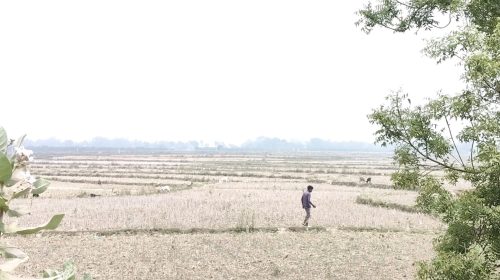
The groundwater crisis is not merely environmental, it is also transforming farmers' autonomy. Photo: Shafiqul Islam
The Barind region is a historically and geographically significant area spanning large parts of Rajshahi and Rangpur divisions in northwestern Bangladesh. Covering approximately 9,320 square kilometers across the districts of Rajshahi, Chapainawabganj, Naogaon, Natore, Bogura, Pabna, Joypurhat, Rangpur, and Dinajpur, the region is now facing an acute groundwater crisis due to climate change and excessive groundwater extraction.
The indiscriminate use of groundwater is pushing the Barind region toward ecological collapse. Livelihoods are increasingly under threat, while the combined effects of climate change and the unplanned, poorly regulated activities of the Barind Multipurpose Development Authority (BMDA) have accelerated environmental degradation. Desertification has already begun in many areas, affecting not only agriculture but also access to drinking water.
BMDA: The Beginning of the Crisis
In 1985, the Barind Integrated Area Development Project was launched under the Bangladesh Agricultural Development Corporation (BADC) to improve the region. The project ended in 1990 and was reconstituted on June 15, 1992, as the Barind Multipurpose Development Authority (BMDA) under the Ministry of Agriculture.
The project approved the installation of 11,400 deep tube wells in Rajshahi, Chapainawabganj, and Naogaon districts, of which BMDA was responsible for 8,400. Today, including privately owned wells, the number of deep tube wells has reached nearly 28,000. Government guidelines regarding tube well installation were largely ignored.
Although BMDA no longer permits new deep tube wells, many existing wells whose water-bearing layers have failed are being re-bored and extended to deeper aquifers.
The long-term environmental consequences of the project may not have been fully anticipated. Former BMDA Chairman Dr. Asaduzzaman later stated that he never envisioned a water-scarce Barind region. His primary objective had been poverty alleviation through increased agricultural and fisheries production. He did not foresee water becoming a commercial commodity, a political instrument, and the basis for the emergence of new social classes. Despite efforts such as afforestation programs, the project has, in many respects, become a “misfire.”
A Motor Pump in Every Household
Water was once considered a common good. Villagers relied on shared ponds and tube wells, and water was a collectively managed resource. Today, groundwater has almost entirely replaced surface water.
In Chaktantihati village of Godagari Upazila, Rajshahi, 21 of the village’s 26 households have installed private motorized water pumps. Installing a pump costs around BDT 28,000–30,000. Each person uses approximately 30–35 liters of groundwater daily, while surface water use has virtually disappeared.
This shift has transformed water from a communal resource into a privately owned commodity. Many households obtain electricity connections under the pretext of poultry farming or small businesses, while actually using the pumps to irrigate up to 10–20 bighas of farmland. The number of such pumps is difficult to estimate.
Together with deep tube wells, these pumps continuously extract what locals describe as “diamond-like droplets” from underground. The cultural and spiritual value of water has been transformed into a purely commercial one—perhaps the greatest tragedy of all.
Dual Governance and Lack of Coordination
Water management in the Barind region is overseen by both BMDA and Upazila Irrigation Committees. Deep tube wells require final approval from the irrigation committees.
A single deep tube well costs approximately BDT 2–2.2 million to install. While BMDA-operated wells generally have better drainage systems and lower water wastage, privately owned wells often lack such infrastructure, resulting in greater losses.
Field observations reveal that under BMDA management, irrigating one bigha of land requires approximately BDT 1,500 in electricity charges and BDT 500 paid to the operator. Costs under private ownership are often even higher.
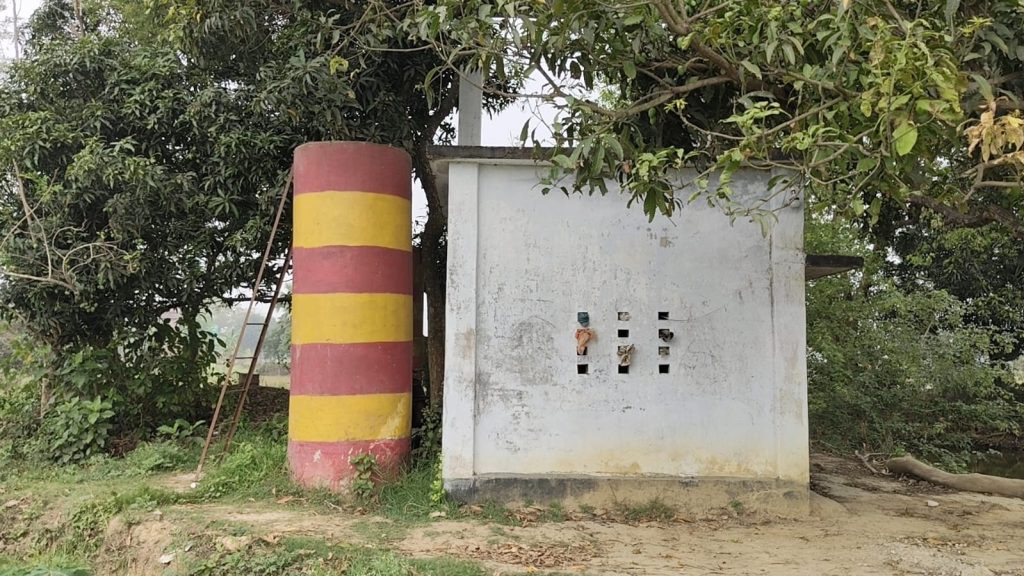
Water management in the Barind region is overseen by both BMDA and Upazila Irrigation Committees. Photo: Shafiqul Islam
In some areas, BMDA tube wells are managed through cooperatives, which tend to operate more effectively because farmers have opportunities to participate in decision-making. In contrast, private well owners determine water prices at their own discretion.
The coexistence of BMDA and irrigation committees has created overlapping authority and coordination failures. In many cases, irrigation committees approve private deep tube wells without considering BMDA’s requirement that wells be spaced at least 2,000 feet apart.
The Decline of Surface Water
Groundwater use in agriculture has increased dramatically because single-crop lands have been converted into triple-crop lands. According to BMDA sources, only 22 percent of irrigation water now comes from surface sources; the remaining 78 percent is extracted from underground.
Government ponds, once major sources of irrigation water, are increasingly leased by politically influential individuals for fish farming. As a result, farmers are often unable to access these water bodies for irrigation.
Similarly, privately owned ponds are either leased out or incorporated into commercial projects, limiting public access. Rivers and canals have also suffered from decades of neglect and siltation, reducing their navigability and water-carrying capacity. Consequently, agriculture and domestic needs now depend overwhelmingly on groundwater.
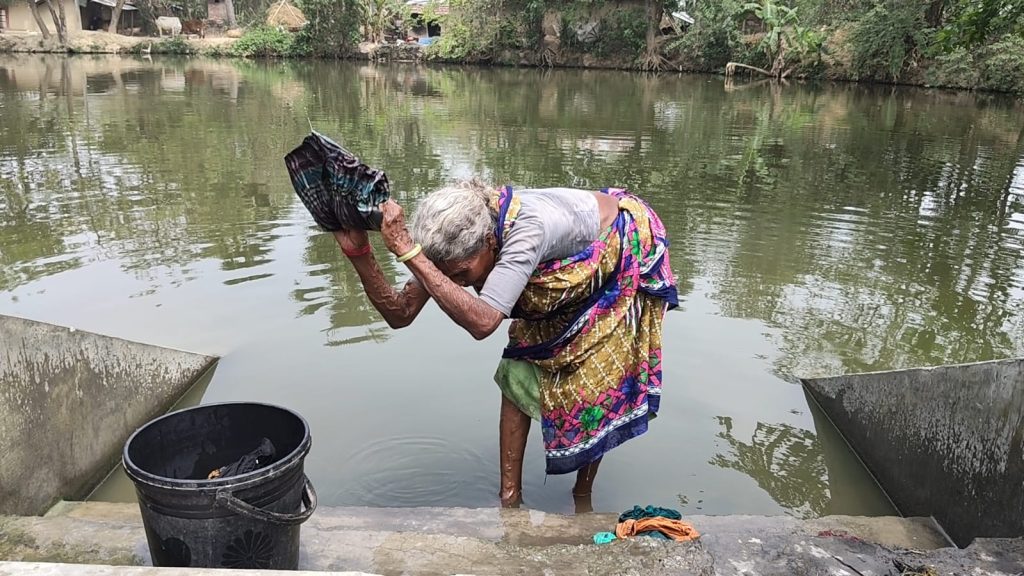
Government ponds, once major sources of irrigation water, are increasingly leased by politically influential individuals for fish farming. Photo: Shafiqul Islam
Groundwater Stress Hotspots
The situation has become so severe that 25 upazilas in Rajshahi, Naogaon, and Chapainawabganj have been declared groundwater-stressed areas.
The government has identified 1,469 mouzas across 47 unions as extremely water-stressed and another 884 mouzas in 40 unions as highly water-stressed.
The crisis has been decades in the making. In Mohammadpur village of Panchandar Union, Tanore Upazila, groundwater levels were only 8–10 feet below the surface in 1984. By 2026, they had fallen to approximately 80 feet. In some elevated areas of Naogaon and Chapainawabganj, water levels have reportedly dropped to depths of 750–1,000 feet.
Aquifers Are Losing Their Water-Holding Capacity
Research indicates that aquifers—the underground formations that store water—are losing their capacity as they dry out. Once an aquifer dries up, its natural characteristics can be permanently altered.
As a result, some areas have become virtually waterless. In places such as Amnura in Chapainawabganj, where rice-processing facilities and numerous deep tube wells are concentrated, excessive extraction has made groundwater increasingly difficult to access. Local communities face growing hardship.
How Much Water Is Being Extracted?
A single deep tube well can extract up to 56 liters of water per second. Yet no comprehensive accounting exists of how much groundwater has been extracted over the past four decades.
The public, who are the true owners of this resource, have little control over its management. Instead, powerful actors profit from groundwater extraction and sales.
A study by the Bangladesh Rice Research Institute found that producing one kilogram of rice required approximately 1,200 liters of water during the 2016–17 fiscal year. When the environmental costs of groundwater depletion, biodiversity loss, and ecosystem degradation are compared with the economic benefits of agricultural production, the true balance becomes clearer.
Field data indicate that irrigation water prices have increased sevenfold over the past two decades.
The Rise of “Water Elites” and “Water Touts”
A new class of “water elites” and “water touts” has emerged around groundwater management, facilitated by BMDA and Upazila Irrigation Committees.
Deep tube wells and irrigation systems are reshaping the region’s economy, social relations, biodiversity, and environment. Universal access to water is shrinking, and every drop now carries a monetary value.
Groundwater has become a key instrument of political power. Deep tube wells are no longer merely irrigation infrastructure—they are power centers. Whenever political power shifts, operators often change as well.
Operators decide which farmers receive water first and which must wait. Their decisions are often final.
Deep Tube Well Operators: Political Networks and a New Cash-Based Class
Most deep tube well operators are aligned with the ruling political establishment. Securing these positions often requires political connections and financial investment.
BMDA pays operators between BDT 10 and 20 per hour. Depending on usage levels, operators can earn between BDT 10,000 and 30,000 per month.
Their influence extends far beyond irrigation. In project-based farming systems, outside investors frequently finance cultivation on lands served by deep tube wells. Operators act as intermediaries and often earn substantial commissions.
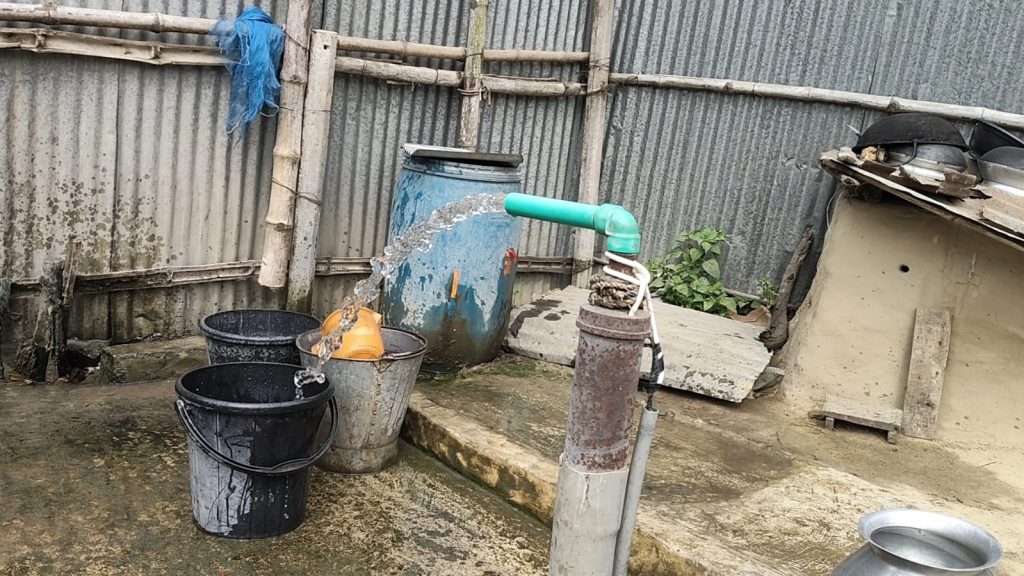
The project approved the installation of 11,400 deep tube wells in Rajshahi, Chapainawabganj, and Naogaon districts. Photo: Shafiqul Islam
For example, if an investor allocates BDT 17,000 per bigha for potato cultivation but farmers receive only BDT 15,000, the operator pockets the difference. In a 200-bigha project, such commissions can amount to BDT 400,000 without any direct investment.
Farmers are often compelled to maintain good relationships with politically connected operators, who also maintain strong ties with seed dealers, fertilizer suppliers, and local power structures. Over time, operators have emerged as a new influential rural class.
Ownership and control over groundwater have effectively shifted into the hands of politically connected, cash-rich actors who may own little land themselves but profit from water trading, pond leasing, fish farming, and commercial agricultural ventures.
Operators Control Agricultural Decisions
The groundwater crisis is not merely environmental—it is also transforming farmers’ autonomy.
Farmers whose land falls under the service area of a deep tube well increasingly lose control over cropping decisions. Whether the well is managed by BMDA or privately owned, operators often determine what crops can be cultivated.
Many farmers report that while they remain the legal owners of their land, they no longer feel like true owners because they cannot freely decide what to grow. Since irrigation is indispensable to agriculture, those who control water ultimately control agricultural decisions.
Deep tube wells have become instruments of political and economic dominance. Farmers remain fragmented and vulnerable, while intermediaries and investors are organized and powerful. Without directly participating in production, these actors extract profits simply by controlling water.
This project-based agricultural system can reasonably be described as a form of neo-colonialism in agriculture.
A Textbook Case of Policy Failure
Bangladesh has a National Water Resources Council, along with numerous ministries, agencies, policies, laws, and plans. The country has a National Water Policy, Water Act, Delta Plan, and commitments under the United Nations Sustainable Development Goals (SDGs).
Yet all these frameworks appear ineffective in protecting groundwater in the Barind region.
The region’s water management system risks becoming a textbook example of policy and institutional failure.
A state’s effectiveness is reflected in how well it manages public resources. If short-term development creates long-term environmental and social disasters, can it truly be called development?
The reckless extraction of groundwater in the Barind region suggests a deeply troubling future. If current trends continue, internal migration will increase, livelihoods will deteriorate, public health will suffer, and the very survival of communities will be threatened.
Because without water, life itself cannot endure.
Urgent government action is therefore essential to halt the alarming decline of groundwater levels in the Barind region.
Author: Ibrahim Khalil, journalist and researcher.