ঢাকাশুক্রবার , ২৩ অক্টোবর ২০২৬

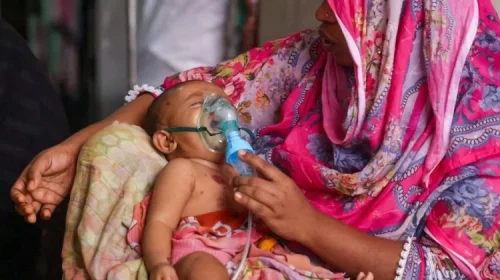
Sharmila Sangma. A middle-aged Garo woman. A three-year-old girl hangs on her back on a winter morning. The child, specially tied to the back with a cloth, is looking down. She has a runny nose due to the cold. The mother left the village in search of a livelihood, leaving the child with her grandmother Sharmila Sangma at the age of 3 months. Her parents work in a garment factory to live from hand to mouth. So, the little child is being raised by her grandmother. But the mark of malnutrition is evident on the child’s face as she wasn’t breastfed and didn’t get nutritious food.
Many tribal women, like Sharmila Sangma’s daughter, have migrated to cities to survive the struggle for their livelihood. Even if they leave the infant safely with other family members, they have to forget the child’s nutrition. This scene is now a daily occurrence in the hilly tribal Garo community in the northeastern part of Bangladesh. The situation is worse for the tribes who have nowhere to go but the hills as their only shelter. There is not enough food in the house, and no water in the hill springs. Due to the legal complication, the ownership of the hill has changed, so they cannot even cultivate the hill.
As they breathed a sigh of relief in the hills for ages, now is in turmoil. Because they are being displaced as the government organizations and powerful people are deforesting the entire hill. Once the entire Garo Hills area was owned by these tribals. Their lives were centered on the hills. Everything was self-sufficient, even though there was not much to ask for.
This matriarchal tribe lives in Tangail, Jamalpur, Sherpur, Mymensingh, Netrakona, Sunamganj, and Sylhet districts of northeastern Bangladesh. However, their main habitat is centered around Garo hills in Mymensingh, Jamalpur, Sherpur, and Netrakona districts. Most of the Garo Hills are in the Indian state of Meghalaya. It is where most of the Garo people live. As they live around the hill, the hill is named Garo Hill after their name.
The height of the Garo Hills in the Indian part is about 4500 feet above sea level. Its length is about 8 thousand square kilometers, and the forest area is about 200 square kilometers. The maximum height of the hill in the Bangladesh part is about 200 to 500 feet. However, due to climate change and man-made destruction in Bangladesh, the Garo Hills are under threat. Once upon a time, there were tigers, bears, deer, monkeys, pigs, and wild cocks in the forests of Garo Hills, but now they are no longer visible. They also disappeared due to the evolution of time and the tyranny of the invaders.

According to the sources of the forest department, the height of this Garo hill on the Bangladesh side is decreasing day by day. The soil is eroding at a rate of about 3 inches per year. Agriculturalists and environmentalists have reported that soil erosion has increased due to the extraction of rock, soil, and sand from the hills and deforestation.
According to Sherpur District Forest Department sources, there are 28 thousand two hundred 51.50 acres of forest land in Jhenaigati, Srivarardi and Nalitabari upazilas of Sherpur alone. Out of this, 3391.17 acres of land have been occupied until 2021. However, the amount of possession demanded by the locals is greater. Meanwhile, conflicts between tribals, Bengalis, and the forest department are increasing over forest land. Again, there are many complaints against government officials and employees for compromising with the occupants in exchange for bribes.
According to the 2022 census, there are 1.65 million ethnic minority people in Bangladesh. Among them, the population of the Garo community is 76,846 people. However, most of the tribals in Bangladesh live in Chittagong, Chittagong Hill Tracts, Rangamati, and Khagrachari, and all the attention is on these districts. So, most of the development work is done there. As a result, the lifestyles and struggles of the tribals of the northeastern region remain invisible.
And the local political leaders exploited this opportunity. Day after day, they have taken possession of the hills by deceiving these simple natives. The government evicted the Garo community and leased the hills to the Bengalis. The government has cut down large trees and planted fast-growing Eucalyptus and Akashmani trees. Which is harmful to the environment! Because these plants absorb excess water.
After visiting these places, it has been seen that the condition of the Garo tribals and hills in Bakshiganj of Jamalpur district is very critical. Most of the hill forests here have been deforested. The forest department has taken the initiative to stop cutting trees in some places due to the objections of environmentalists. Still, the cutting of trees does not stop. To evade the forest department, many smugglers cut down trees, burn them to make charcoal, and take them out of the forest. They sell each bag of coal for only BDT. 500 (4.20 euros). While traveling in the Garo Hills, I came across several such tree-cutters and coal traders. They also spoke in a threatening tone while I was taking pictures. It is easy to understand how helpless the tribals are in front of their threats.
The helplessness of the tribals can be seen further inside the Garo Hills. I saw a tribal family there, and they were forced to harvest raw paddy. They said there are still at least 20 days left for the rice to ripen. Not all paddy were ready to harvest. But a local tree trader is cutting trees on the paddy field. So, they are forced to harvest the paddy before it spoils. They used to get about 20 kg of paddy per 0.012-acre field if the paddy was ripe. But because the paddy is cut before maturity, they may not get even 5 kg of paddy per 0.012 acre!
The tribals told how the Bengalis took over the entire hill by leasing a few acres of land at the foot of the hill. There, Bengalis regularly cut and sell hill trees. The cutting down of large trees has greatly affected the lives of the tribals. Although the Garo Hills were once known for rain, the average rainfall has now declined there. Hill springs were once the main source of water for agriculture and drinking water for the tribals, but now they almost dry up during the winter season. There is no food in the hills like before. As a result, they are forced to move to the city even though they have been living in the hills for several hundred years!
Moreover, they are not getting good jobs in the city due to lack of education. They don’t know why it happened to them, how it happened, or who is responsible for this. Not in their despair or regret, the impact of climate change is evident in their appearance.

The Garo tribals celebrate the Wangala (Nabanna) festival every year. They did this festival last year as well. I also attended this festival. Wangala is the festival of bringing home the new harvest; it is a festival of worship to God in thanksgiving for the harvest. But their crops are not as good as before. Still, the sincerity of these people towards God does not decrease. The whole society worships God for crops. Slaughter pigs with the father of the church in the festival, feed the poor and eat themselves. But these simple people do not understand why God does not listen to their calls to increase crop yields and eliminate scarcity.
These people do not understand climate change. They do not even know why the once-full springs have dried up and turned into sand. They don’t even know why their rights have been taken away from the ownership of hills and the embrace of trees. They only understand hunger. To escape from the pain of hunger and to survive, leave the suckling child and go to the city in search of livelihood. However due to climate change and man-made destruction, they can no longer find the peace that has been lost in the hills.