ঢাকাবুধবার , ১৮ নভেম্বর ২০২৬
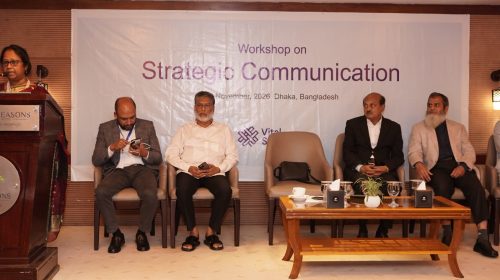
Vital Strategies hosted a workshop with government, civil society, academia, journalists, communication and public health stakeholders today to accelerate alignment on strategic communication for tobacco control. The government is collaborating with Vital Strategies to educate the public about the recent provisions added to tobacco control law – the Smoking and Tobacco Products Usage (Control) Act 2005—via a 2026 amendment.
“Communication is key to sensitizing the public to tobacco control laws and changing the behavior of tobacco consumers,” said Sheikh Momena Moni, Additional Secretary (World Health wing) of the Health Services Division during her opening remarks at the session. “It is also useful for educating the public, members of taskforce committees and officials concerned with implementing the new provisions of the tobacco control law added in the 2026 amendment.”

The event was presided over by Md Shafiqul Islam, Senior Consultant at Vital Strategies, with participation from Dr. A K M Mamun Uzzaman, Director at NGO Affairs Bureau; MD. Akhteruzzaman, Director General at the National Tobacco Control Cell; Md. Hamidur Rahman Khan, former Senior Secretary; Md Mostafizur Rahman, Lead Policy Adviser at Campaign for Tobacco Free Kids, Khaleda Begum, Director General at Department of Films and Publications, and Md. Zeaur Rahman, Director – Road Safety at Bangladesh Road Transport Authority (BRTA). Opening session moderated by Aminul Islam Sujon, Technical Adviser at Vital Strategies.
“The newly strengthened tobacco control law includes historically significant changes–expanding smoke-free spaces, limiting the marketing of tobacco products, and clamping down on the industry’s use of “corporate social responsibility” initiatives to improve its image – but these changes won’t mean anything if government officials and citizens are unaware of them,” said Md Shafiqul Islam of Vital Strategies. “Enforcement and compliance are key to ensuring these provisions have their intended impact, and strategic communication is the vehicle to get us there. We are grateful for the opportunity to guide the government in its efforts to raise awareness of the comprehensive law.”
The day-long program featured technical sessions tracing the evolution of mass media campaigns, portraying the media environment, elaborating social media and digital outreach strategies, and providing key updates on the Smoking and Tobacco Products Usage (Control) Amendment Act. Sessions were facilitated by Aminul Islam Sujon and Fahmida Islam at Vital Strategies, Dr. Asma Sultana Tuli at the National Tobacco Control Cell and Syeda Anonna Rahman at Work for a Better Bangladesh (WBB) Trust.
Participants designed targeted strategic communication interventions via interactive working sessions and prepared communication strategies that could help counter tobacco industry interference in implementation of the provisions of the amendment.
Facilitators underscored the critical role of communicators and journalists in exposing industry tactics and educating the public—especially youth—about the dangers of conventional tobacco and emerging products like electronic cigarettes (also known as vapes).
The 40 workshop participants from government, civil society, media, academia and public health are now better equipped to share strategic and timely messaging with their audiences regarding enforcement of the new tobacco control measures in Bangladesh.
Tobacco use kills almost 200,000 people every year in Bangladesh. This devastating toll can be reduced by implementing tobacco control policies that are proven to reduce consumption. Measures such as increasing tobacco taxes, eliminating tobacco advertising, promotion and sponsorship, establishing 100% smoke-free environments, and warning the public about tobacco harms are part of the World Health Organization’s MPOWER package of tobacco control policies. They are enshrined in the WHO Framework Convention on Tobacco Control, to which Bangladesh is a party.