ঢাকাশনিবার , ১৯ সেপ্টেম্বর ২০২৬
The footprint of climate change is now evident in every corner of the planet. Rising temperatures, sea-level surges, and extreme weather events are not only disrupting human life but are also fundamentally altering the map of global biodiversity. The inhabitants of forests, mountains, and oceans are now struggling for survival. A recent research-based report by the renowned environmental news outlet Mongabay has revealed alarming data regarding this crisis.
The report suggests that the behavior of wildlife regarding habitat migration is far more complex, irregular, and uncertain than scientists had previously predicted. This unpredictable movement poses a massive challenge for forest researchers, environmentalists, and policymakers, effectively shaking the foundations of modern conservation strategies.
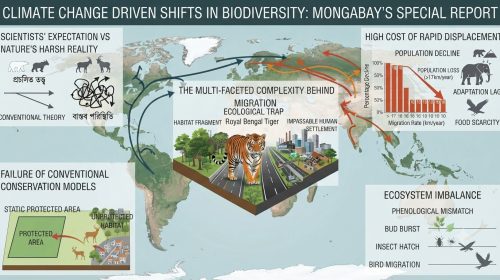
Scientists’ Expectations vs. Nature’s Harsh Reality:
Until now, the prevailing scientific theory was that as the planet heated up, animals would quickly migrate toward the poles or higher, cooler altitudes in search of safety. Researchers expected a linear or specific migratory process. However, modern satellite tracking and detailed field observations show that nearly half of all animal movements do not align with this conventional wisdom.
Dr. Gregory Lindley, a researcher at the Lindsay Wildlife Experience, states, `We are mistaken if we think animals are just chasing a specific temperature. The issue of ecosystem survival is far more complex.’ He explains that animals are not just following a map; they are constantly fighting against local topography and adversity. Many are moving south instead of north, while others are dispersing aimlessly without any specific direction.
The Complexity Behind Migration:
Temperature rise is not the only cause for this erratic behavior. Ecosystem dynamics expert Dr. Sarah Aronson notes, `Many species are moving into areas that were not even in our previous models. They are venturing outside historically protected areas where they have no safety.’ She adds that these irregular movements lead them into human settlements, increasing the risk of extinction.
Human-built roads, urbanization, and factories have shattered natural wildlife corridors. In many cases, a species sets off toward a safe haven, only to encounter a massive highway or human settlement midway. They become trapped in what is known as an `ecological trap’—a place where they may have fewer natural predators, but human-made barriers leave them stranded.
The High Price of Rapid Relocation:
Another worrying finding is that species forced to relocate rapidly—averaging over 17 kilometers per year—face a 50 percent risk of population decline within just a decade.
Environmental expert Dr. Marcus Thompson explains, `For animals migrating rapidly, ‘adaptation lag’ is a critical issue. They are dying from exhaustion or starvation before they can adapt to the new environment. This isn’t just natural migration; it is a dangerous form of the struggle for survival.’ They are failing to reach their destinations, succumbing to food scarcity, new parasites, or diseases. It is a death race where their existence vanishes before they even reach the finish line.
Failure of Conventional Conservation Models:
Currently, National Parks and protected areas worldwide are static within fixed geographical boundaries. But if animals move beyond these limits, they lose all legal protection. Criticizing current policies, conservation planner Dr. Elena Rodriguez says, `Our current National Parks are stagnant compared to the rate of climate change. We must preserve areas that align with the shifting routes of animals. The current boundary-setting method needs rapid change; otherwise, we are just protecting maps while the animals disappear in reality.’
She further suggests adopting a `Dynamic Conservation Model.’ Governments may need to adjust the boundaries of protected areas over time to ensure that animals remain under legal protection wherever they seek shelter.
Ecological Imbalance:
Climate change is not just raising temperatures; it is breaking the internal food chains of ecosystems. Researchers call this `phenological mismatch.’ For example, if a bird arrives at a specific area for breeding, but the timing of food or insect availability has shifted due to climate change, the birds perish due to hunger. The Mongabay report clearly indicates that we are not just witnessing changes in migration routes; we are seeing the disruption of the entire temporal rhythm of the ecosystem.
The Crisis in the Sundarbans:
Rising sea levels and increased salinity are shrinking the habitat of spotted deer in the Sundarbans. Consequently, tigers are forced to stray into human localities, escalating human-wildlife conflict. This is a classic example of an `ecological trap,’ as tigers get stuck when they venture out in search of safer ground and run into human infrastructure.
Fragmentation in the Chittagong Hill Tracts:
Elephant corridors in the Chittagong Hill Tracts and Cox’s Bazar are fragmented by development. Research shows that as animals lose their way, human-elephant conflicts have increased. Moreover, a “phenological mismatch” is leaving them without traditional forest food sources as the timing of fruit and forest produce changes.
The Endangered Journey of Migratory Birds:
Every winter, thousands of migratory birds visit the wetlands of Bangladesh. Due to climate change, the weather in Siberia or the Himalayas has changed, altering their arrival times and routes. Experts say many birds no longer visit Bangladesh because their traditional stopover points have become uninhabitable.
Dr. Arman Chowdhury, a senior fellow at the Forest and Climate Research Institute, expresses deep concern: “The animals are behaving in a far more uncertain and chaotic manner than we have ever seen. Our protected forests are no longer sufficient. When they move in search of food or climate refuge, they get caught in the web of human settlements and infrastructure.”
Integrating Technology and Research:
Experts believe relying solely on technology won’t solve this crisis. Building `eco-bridges” or “underpasses’ when constructing roads through forests is essential. Furthermore, areas where animals are migrating must be identified as environmentally sensitive zones beforehand. By integrating the knowledge of indigenous and forest-dependent communities with research-driven policies, we can create models where wildlife movement is compatible with economic activity. Implementation is the only path to protecting these forest dwellers.