ঢাকাশনিবার , ১৯ সেপ্টেম্বর ২০২৬
Through well-planned road design, it is possible to ensure safe road crossing for pedestrians and control excessive vehicle speeds by installing raised crossings (elevated pedestrian crossings aligned with the sidewalk) and speed-limiting measures before traffic signals and zebra crossings. If vehicle speeds can be effectively controlled, roads will become significantly safer for pedestrians.
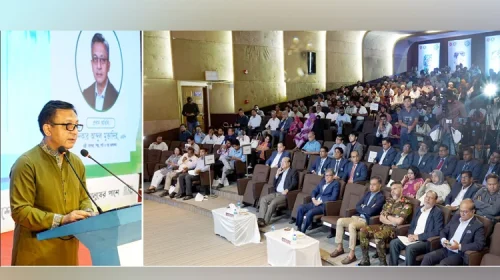
Speakers made these remarks at a training workshop held today (11 July) at the DNCC auditorium, organized jointly by the Dhaka North City Corporation (DNCC) and the World Resources Institute (WRI). The day-long training, conducted under the Bloomberg Philanthropies Initiative for Global Road Safety (BIGRS), was inaugurated by DNCC Administrator Md. Safiqul Islam Khan. The event was chaired by Md. Abdul Wadud, BIGRS Bangladesh Coordinator and former Additional Secretary. Special guests included DNCC Chief Executive Officer (Deputy Secretary) Muhammad Asaduz Zaman, Chief Engineer Brig. Gen. Syed Raquibul Hasan, PSC, and Additional Chief Engineer Khondoker Mahbub Alam. The inaugural session was moderated by Aminul Islam Sujon, Technical Advisor at Vital Strategies.
DNCC Administrator Md. Safiqul Islam Khan said that roads in Dhaka North will gradually be made safer. To achieve this goal, it is essential to enhance the capacity of engineers, urban planners, and architects involved in road design, construction, and management, also strengthen coordination among agencies responsible for road construction and management is also essential. He added that collaboration with all relevant governments, private-sector, and international organizations would be further strengthened in the future.
DNCC administrator stated that the Honorable Prime Minister is highly supportive of integrated urban development, including road safety. The ongoing road safety activities in Dhaka under the partnership between DNCC and the Bloomberg Philanthropies Initiative for Global Road Safety (BIGRS) will be presented to the Prime Minister. The DNCC Administrator also urged engineers to utilize the experience and expertise of international organizations in developing safer road designs to reduce public inconvenience and risks on the roads.
DNCC Chief Engineer Brig. Gen. Syed Raquibul Hasan said that efforts are underway to make roads under DNCC’s jurisdiction safer. In coordination with the Dhaka Metropolitan Police (DMP), crash data are being collected and analyzed to identify high-risk roads, which are then being redesigned to improve safety. Training is also being provided to DNCC engineers and urban planners on safe road design principles.
DNCC Chief Executive Officer Muhammad Asaduz Zaman said that DNCC has already organized training programs to encourage journalists to produce solution-oriented reporting on road safety and conducted mass media campaigns to raise awareness among drivers and road users about speed limits. He requested Vital Strategies to further expand the scope of these initiatives.
Md. Abdul Wadud, BIGRS Bangladesh Coordinator, highlighted global road safety initiatives and said that under this program, which operates in more than 27 densely populated cities worldwide, various activities are being implemented to prevent premature deaths on roads. These include designing safer roads and infrastructure, managing vehicle speeds, ensuring safe pedestrian crossings, increasing awareness of speed limits and traffic laws, improving enforcement of existing traffic regulations, and supporting the development of comprehensive road safety legislation.
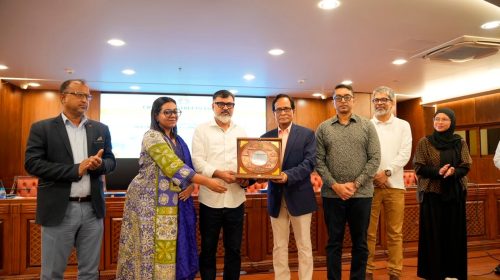
At the event, four DNCC officials were awarded honorary plaques in recognition of their active contributions to safe road design. The recipients were Assistant Engineer Shyamal Kumar Sarkar and Sub-Assistant Engineers Md. Sohel Rana, Md. Babar Ahmed, and Md. Mohinur Islam. The commemorative awards were presented by the DNCC Administrator. On the occasion, representatives of the international organization WRI also presented a token of appreciation to the DNCC Administrator.
During the training, various sessions were conducted on topics such as Safe Road Design in the Bangladesh Context, International Experience in Road Safety, and Road Design for Speed Management. The sessions were led by Farzana Islam Toma, Consultant at WRI, Arina Tahnim, Associate Consultant, and Retno Whinanesta, Urban Resilience and Knowledge Management Manager. In addition, Sohel Rana, General Manager (Planning) of Dhaka Mass Transit Company Limited (DMTCL) South and Deputy Project Director (Deputy Secretary) of Metro Rail Line-5, delivered a presentation on integrating metro rail services with road transport systems in Dhaka.
Drawing on both institutional and academic experience, the trainers highlighted the importance of integrating urban and transport planning, the role of infrastructure design in road safety, and the measures needed to ensure safe mobility for all road users. Participants were divided into groups to discuss various aspects of safe road design and later presented their findings in group presentations. The group discussions were coordinated by Engineer Md. Rezaur Rahman, Transport Coordinator of BIGRS.
Farzana Islam Toma stated that the importance of infrastructure design in ensuring road safety has been proven worldwide. Referring to examples from different countries, she noted that roads in developed nations are often designed with priority given to pedestrians and cyclists, making them safer for everyone. She emphasized that making Dhaka’s roads safer requires designing streets that prioritize vulnerable road users, including pedestrians.
Mass media campaign video titled “Rebecca’s Story” who lost her loved one with calling of action for limiting speed was screened to promote awareness of speed limit guidelines. For the joint campaign by DNCC, DMP, BRTA, DTCA and other relevant institutions, the video, produced by the international organization Vital Strategies, is being used by to support road safety initiatives in Dhaka and Bangladesh.
At the closing ceremony in the afternoon, DNCC Chief Engineer Brig. Gen. Syed Rakibul Hasan presented certificates to the participants. He thanked WRI and BIGRS for organizing the training to enhance the capacity of officials from DNCC, BRTA, DMP, and DTCA. He also requested WRI to organize more frequent and larger-scale training programs of this nature in the future.
More than fifty engineers from DNCC participated in the training. Officials from the Bangladesh Road Transport Authority (BRTA), Dhaka Metropolitan Police (DMP), Dhaka Transport Coordination Authority (DTCA), and the Roads and Highways Department (RHD) also attended.
Among those present were Mamunur Rahman, Senior Road Safety Specialist at DTCA; Subir Kumar Sarkar, Deputy Director of BRTA; Nayeem Rayhan Khan, Executive Engineer (Traffic Engineering Circle) of DNCC; Golam Rahman, Enforcement Coordinator of BIGRS; and Dr. Tanvir Ibn Ali, Surveillance Coordinator of BIGRS.