ঢাকাসোমবার , ১৯ অক্টোবর ২০২৬
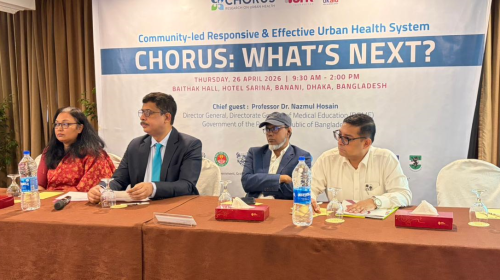
The Community-led Responsive and Effective Urban Health System (CHORUS) programme convened its final dissemination event today in Dhaka, bringing together policymakers, health experts, development partners, researchers, and media representatives to share key findings and identify priorities for strengthening urban primary healthcare systems in Bangladesh.
Hosted by ARK Foundation at Hotel Sarina, the event titled “Community-led Responsive and Effective Urban Health System (CHORUS): What’s Next?” highlighted evidence generated through the CHORUS consortium, which operates across Bangladesh, Nepal, Ghana, and Nigeria to improve health outcomes for the urban poor.
In her opening remarks, Professor Rumana Huque, Executive Director of ARK Foundation, underscored the growing vulnerabilities within Bangladesh’s urban health system.
She noted that one of the key lessons from CHORUS is that there is no single solution. Strengthening urban health systems requires a comprehensive approach that addresses governance, financing, service delivery, workforce, and data systems together, while ensuring that the voices of communities remain central.
She further emphasised that Bangladesh is not alone in facing these challenges. Across CHORUS countries, similar patterns of rapid urbanisation, inequities, and health systems under pressure are evident, creating opportunities for shared learning and collaboration across regions.
Highlighting the current public health context, she added, “Bangladesh is currently facing one of its most significant measles outbreaks in recent years. This is not just a public health event; it is a clear signal that gaps in service delivery and system coordination can quickly reverse progress if not addressed.”
The event featured presentations by CHORUS researchers on strengthening urban primary healthcare, improving financing mechanisms, and enhancing service delivery in rapidly urbanising settings.
The Chief Guest, Professor Dr. Nazmul Hosain, Director General of the Directorate General of Medical Education (DGME), stated, “Anyone who can identify effective pathways for strengthening healthcare in Bangladesh should make use of the opportunities provided by the current government, as outlined in its manifesto.”
He also added, “Strategic partnerships and purchasing mechanisms, led by autonomous urban authorities such as DNCC, along with public-private partnership models and integration of systems like iBAS++, are key to ensuring transparency and integrity in urban health systems.”
Dr. Md. Shafiqul Islam, Health Advisor at the British High Commission Dhaka, remarked, “The key findings from research should be translated into actionable policies, particularly to strengthen integrated primary healthcare.”
A panel discussion involving leading health experts and stakeholders further explored practical strategies to address urban health challenges, particularly for low-income populations. The discussion featured Dr. Mahmuda Ali, Health Officer at Dhaka North City Corporation (DNCC); Dr. Mahmudur Rahman, former Director of the Institute of Epidemiology, Disease Control and Research (IEDCR); Dr. Syed Zakir Hossain, former Line Director of Noncommunicable Disease Control (NCDC), DGHS; and Mohammad Zahirul Islam, Senior Health Advisor at the Swedish International Development Cooperation Agency (SIDA), Embassy of Sweden, Dhaka.
The session was attended by a wide range of participants, including representatives from government, non-governmental organisations, development partners, and media, contributing to a dynamic and multi-perspective discussion on the future of urban health systems in Bangladesh.
CHORUS, a multi-country research consortium, works through key pillars including linking diverse health providers, promoting multisectoral collaboration, addressing both communicable and non-communicable diseases, and engaging urban communities. In Bangladesh, the programme has generated critical evidence to inform policy and strengthen urban primary healthcare systems.