ঢাকাবৃহস্পতিবার , ৬ অগাস্ট ২০২৬
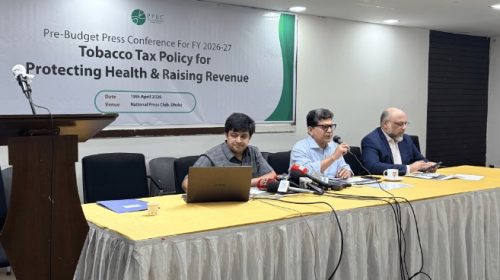
Power and Participation Research Centre (PPRC) has presented a set of policy recommendations outlining urgent measures that the government could incorporate into the FY 2026–27 national budget to both protect public health from the harms of tobacco and enhance revenue generation. These recommendations were shared at a press conference titled “Pre-Budget Press Conference for FY 2026–27: Tobacco Tax Policy for Protecting Health & Raising Revenue,” held on April 19, 2026, at the Zahur Hossain Chowdhury Hall of the National Press Club in Dhaka.
The proposal for FY 2026–27 recommends merging the existing low and medium cigarette price tiers and establishing a unified minimum retail price of BDT 100 per 10-stick pack. In addition, the government is urged to introduce a specific excise tax of BDT 4 per 10-stick pack, to be applied uniformly across all cigarette price tiers. The proposal has been jointly developed by Economics for Health, the World Health Organization (WHO), and the Institute of Health Economics (IHE), University of Dhaka, as part of broader efforts to strengthen tobacco control and improve domestic revenue mobilization.
The keynote speaker, Dr. Shafiun N. Shimul, Professor and Director of the Institute of Health Economics (IHE), University of Dhaka, emphasized that, if the proposed tax measures are effectively implemented, it is projected that approximately 500,000 adults will be encouraged to quit smoking, while more than 372,000 young people will be deterred from initiating tobacco use. Over the long term, these measures could avert an estimated 185,408 premature deaths among adults and 185,335 among the youth population. Furthermore, the overall prevalence of tobacco use is expected to decline by around 0.5 percentage points. Instead, if the proposal is implemented, it is anticipated to generate in excess of BDT 85,000 crore, generating an additional BDT 44,000 crore compared to the previous fiscal year.
Attending the press conference, Prof. Dr. Syed Md. Akram Hussain, Chairman of the Department of Clinical Oncology, echoed the keynote speaker, stating, “The economic burden of tobacco-induced non-communicable diseases far exceeds the revenue generated from tobacco taxation, as tobacco use damages not only the lungs but multiple vital organs.” He further emphasized that while incomes have increased and inflation has risen in recent years, tobacco taxes have not been adjusted accordingly.
Dr. Hossain Zillur Rahman, Executive Chairman of PPRC, began his remarks by highlighting taxation and legislative processes as the primary tools for tobacco control. He stated, “Bangladesh’s tax policy analysis remains constrained by misconceptions. The assumption that increasing prices will reduce revenue is flawed, as there is no solid research evidence to support this claim. On the contrary, evidence suggests that higher prices discourage adolescents from initiating smoking—thereby helping to protect our youth.”
He also expressed concern over the removal of the ban on e-cigarettes in the recently passed tobacco control ordinance in Parliament, noting that this decision was made without any clear explanation. According to him, such a move sends a dangerous signal to the public, particularly to young people who are highly susceptible to misinformation. He emphasized that the government must play a more proactive role in safeguarding youth from emerging tobacco-related risks.
In conclusion, he emphasized that alongside taxation and tobacco control laws, it is crucial to raise public awareness—particularly by introducing and strengthening school health curricula to educate young people about the risks of tobacco use.
Speakers across the panel emphasized the urgency of tobacco tax reform, particularly in light of Bangladesh’s ongoing challenges in meeting national revenue targets. Strengthening tobacco taxation is viewed not only as a critical revenue-generating mechanism but also as a highly effective strategy for reducing tobacco consumption and improving public health outcomes.