ঢাকারবিবার , ২৫ অক্টোবর ২০২৬
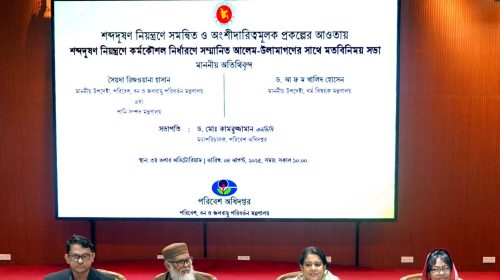
The Government of Bangladesh is seeking the support of Islamic scholars to combat the country’s growing noise pollution problem. Syeda Rizwana Hasan, Advisor to the Ministry of Environment, Forest and Climate Change and the Ministry of Water Resources, made the appeal during a high-level consultation meeting held on Monday at the Department of Environment.
Addressing a gathering of prominent Islamic scholars from across the country, Advisor Hasan emphasized the potential of religious sermons to influence public behavior on environmental issues. “Messages on reducing plastic pollution, preventing hill cutting, and stopping illegal stone extraction—if integrated into religious discourse—can bring meaningful behavioral change,” she said.
Hasan noted that several countries have made substantial progress in controlling noise pollution through joint government and community initiatives. “We don’t want to limit ourselves to speeches—we are ready for real action. It is time to establish regulated noise management in concerts, ambulances, and the transport sector,” she added.
Dr. A.F.M. Khalid Hossain, Advisor to the Ministry of Religious Affairs, underscored that Islamic teachings advocate for moderation in sound and behavior. Citing Hadiths, he pointed out that excessive noise—especially during late-night hours—can severely affect children, the elderly, and the sick. “Noise doesn’t just hurt the ears—it disrupts the nervous system. Unnecessary honking and loudspeakers are inconsistent with Islamic principles,” he said, urging scholars to lead public awareness efforts against all forms of pollution.
Other speakers at the event included Dr. Farhina Ahmed, Secretary of the Ministry of Environment, Forest and Climate Change; Dr. Md. Kamruzzaman NDC, Director General of the Department of Environment; Professor Dr. Kamrul Hasan Torofdar, Secretary General of the ENT Head-Neck Cancer Foundation; Md. Abdullah Al Masud, Director (Deputy Secretary, Administration) at the Department of Environment; and Farid Ahmed, Project Director of the Integrated and Participatory Noise Control Project.
The attending scholars expressed their commitment to preparing a formal set of recommendations for the government. Advisor Hasan pledged that the government would disseminate environmental messages rooted in the Quran and Hadith to foster public awareness.
“With collective efforts grounded in religious values, we can build a more environmentally conscious Bangladesh,” she concluded.