ঢাকারবিবার , ২৫ অক্টোবর ২০২৬
On hot summer afternoons, when life slows under the scorching heat, the mango, lychee, and guava orchards across rural Bangladesh come alive with an intense, rhythmic hum. Hidden among the leaves, cicadas create a continuous buzz that fills the air. Recent findings by scientists have now shed new light on the species responsible for this familiar seasonal soundtrack.
A joint team of researchers from Bangladesh, China, and India has identified a new cicada species inhabiting fruit orchards across the country. Named Dandubia annandalei bullardi, this grass-green insect stays perched on tree branches. A study examining its life cycle, morphological features, and geographic distribution has recently been published in an international scientific journal. The species was confirmed through extensive field sampling, structural analysis, and environmental data modeling.
While researchers suggest that climate change may expand the insect’s potential habitat, its economic impact or threat to horticultural crops remains unknown. Entomologists from Bangladesh Agricultural University (BAU) emphasized that identifying the species is only the first step, advocating for long-term monitoring to understand its life cycle and develop pest management strategies if required.
The study was jointly led by Prof. Dr. Mohammad Abul Manjur Khan from the Department of Entomology at BAU and researcher Cong Wei from Northwest A&F University in China. Indian researcher Babu Saddam and BAU master’s student Shahmat Jawad were directly involved in field data collection, sampling, and species identification. The research paper has been published in the international peer-reviewed journal Insects.
# Live adult green; turns brown when dried
# Elevation and temperature act as key drivers of distribution
# Rising global warmth expanding favorable habitat
# Further research urged to assess actual agricultural impact
Research Methodology & Sample Collection :
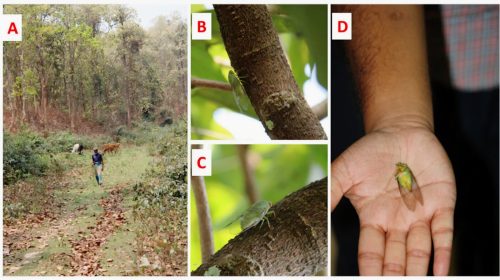
Between February and March 2025, researchers conducted a two-month field survey across various regions of Bangladesh, collecting a total of 63 samples. These specimens are currently preserved in the museum of the Department of Entomology at BAU. Among them, a female cicada sample was collected from underneath a streetlight on the university campus.
The survey recorded the presence of the species across diverse fruit orchards, including mango, lychee, dragon fruit, guava, pineapple, banana, jackfruit, lemon, and orange. In addition, adult cicadas and their shed exoskeletons were identified on trees and bushes such as Sal, bamboo, teak, and Jarul.
Morphological Features & Biodiversity :
Morphological analysis revealed that Dandubia annandalei is typically grass-green when alive, though its color shifts to brown once dried. While externally similar to Dandubia terpsichore, the specific anatomical structure of the male insect serves as a key distinguishing feature for species identification.
Previously, only one species of the genus Dandubia—Dandubia ensifera—was documented in Bangladesh. The discovery of Dandubia annandalei adds another species to the country’s cicada biodiversity record.
Environmental Factors & Habitat Suitability :
Prof. Dr. Mohammad Abul Manjur Khan noted that the team utilized a species distribution model known as ‘MaxEnt’ to project the insect’s current and future geographical spread. By combining field occurrence data with environmental variables such as rainfall, temperature, and elevation, the model mapped potential suitable habitats.
Results indicate that rainfall is the primary factor influencing the species’ distribution. Fluctuations in rainfall during the warmer months of the year significantly alter habitat suitability. Elevation and temperature were also identified as key contributing factors.
Researchers estimate that approximately 861,000 square kilometers across the study region currently offer suitable habitat conditions for the species. Within this area, nearly 300,000 square kilometers are classified as highly suitable, while 179,000 square kilometers are moderately suitable.
Climate Change & Future Projections :
Projections based on climate change scenarios suggest that under a low-emissions scenario, the species’ suitable habitat could expand to nearly 1.75 million square kilometers by 2060, reaching around 1.94 million square kilometers by the end of the century.
Under a high-emissions scenario, suitable habitat area may temporarily contract by mid-century before rapidly expanding to approximately 2.63 million square kilometers by the year 2100.
Researchers explained that shifts in temperature and precipitation patterns inevitably alter insect distribution boundaries. However, they cautioned that the habitat expansions predicted by the MaxEnt model represent environmental suitability forecasts rather than a guaranteed assessment of agricultural damage.
Agricultural Impact & Life Cycle :
In their immature stages, cicadas primarily feed on plant xylem sap, which transports water and minerals throughout the tree. Although certain cicada species are known to harm crops and trees, this study did not evaluate the extent of agricultural damage caused by Dandubia annandalei in Bangladesh. Consequently, the projected expansion of potential habitats does not automatically imply widespread crop damage.
Expert Opinions & Call for Action :
Highlighting the phenomenon, Prof. Dr. Mohammad Abul Manjur Khan said, `Cicadas are widely present in various fruit orchards across the country. During summer, as mangoes ripen, their loud mating calls are commonly heard around trees, signaling their active presence.’
He further added, `Commercial fruit cultivation is expanding in the hilly regions of Bangladesh. According to the MaxEnt model, parts of these regions fall within the cicada’s potential expansion zone. However, adequate research has yet to be conducted on whether the insect adversely affects commercial fruit production or tree growth in those areas.’
Prof. Khan stressed the need for further investigation, stating, `Identifying a new species is not enough. It is crucial to determine its distribution, life cycle, feeding habits, and potential economic damage to agriculture. If found to be economically harmful, effective management strategies must be developed.’
Addressing the future direction of research, he concluded, `Long-term field research is essential to evaluate potential agricultural risks. Institutional support and funding from both public and private sectors are needed to monitor its presence, damage severity, and management requirements, particularly in commercial fruit orchards across hilly regions.’
Researchers believe that with adequate research support, continuous monitoring will yield reliable insights into the species’ ecological spread and actual impact on agriculture, enabling timely and effective preventive measures if economic risks emerge.