
ঢাকাশনিবার , ১৯ সেপ্টেম্বর ২০২৬
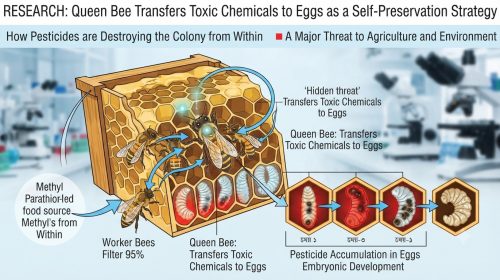
In a startling discovery that has sent shockwaves through the scientific community, researchers at the University of California, Davis, have revealed that queen bees are transferring toxic pesticides into their own eggs as a survival mechanism. The study, recently published in the prestigious journal Current Biology, suggests that this `maternal offloading’ of toxins poses a grave threat to global bee colonies and long-term agricultural stability.
The research was conducted by the Department of Environmental Toxicology at UC Davis, led by Associate Professor Saharah Nicklish and PhD graduate Angela Enseado-Manriquez. The team also included experts from the Lawrence Livermore National Laboratory and the U.S. Department of Agriculture, all working to understand how pesticide exposure ripples through generations of bee colonies.
Research Highlights:
The study unveiled a unique yet self-destructive defensive behavior in queen bees, which researchers have termed `maternal offloading.’ Traditionally, it was believed that worker bees protected the queen and larvae by filtering out toxic particles from food and pollen. It was long assumed that this constant protection kept the queen entirely safe.
However, the new study found that when pesticide levels in an area become excessive, the worker bees’ filtering capacity eventually collapses. When this protection barrier fails, the queen bee herself becomes exposed to toxic chemicals. To save her own life, she offloads this toxic burden by sequestering the chemicals directly into her eggs.
Researchers verified this behavior in a laboratory setting using artificial `nanocolonies,’ each containing one queen and 60 worker bees. They were fed food mixed with a specific pesticide called `methyl parathion.’ To track the movement of the poison, a low-level radioactive marker was added to the pesticide.
Lawrence Livermore National Laboratory scientist Bruce Buchholz explained that they used advanced biological accelerator spectrometry technology. This enabled the detection of the radioactive markers at the atomic level. Testing revealed that while worker bees could filter 95 percent of the pesticide on the first day, their capacity dropped to 86 percent by the 10th day. Essentially, the supply of poison in the colony exceeded the workers’ control.
Perspectives from Researchers:
Senior author Saharah Nicklish stated, `The queen bee offloads toxic chemicals into her eggs to ensure her own survival. This type of self-protective yet destructive behavior in bees has not previously been observed by scientists.’
Lead author Angela Enseado-Manriquez added, `As pesticides accumulate in the eggs, the normal development of the embryo is hindered. This acts as a long-term and silent cause behind colony collapse. Worker protection has a limit, and once that limit is crossed, the queen uses her eggs as a final weapon.’
Context and Crisis in Bangladesh:
In the context of Bangladesh’s agricultural system, chemical pesticides are used extensively to combat crop pests. These toxic chemicals, particularly in rice, vegetable, and fruit fields, are directly impacting local bee colonies. The study’s results are extremely concerning for Bangladesh, where a significant portion of the agricultural economy depends on natural pollination by bees. If queen bees in the country begin transferring toxins into their eggs, colonies will eventually wither from within, causing pollination processes to collapse and crop production to plummet.
Invisible Threat and Farmer Awareness:
In Bangladesh, concerns among farmers and the Department of Agricultural Extension usually revolve around the immediate death of bees. However, according to this study, pesticide use is leading bee colonies toward a silent or slow death—an unacknowledged, major risk for farmers. When a farmer does not realize how their chosen pesticide destroys a colony through the queen’s eggs, they are inadvertently harming their own crops. Overcoming this invisible threat requires increased awareness among farmers.
Solutions and Recommendations:
According to the researchers, the only way out of this crisis is the adoption of `Integrated Pest Management’ (IPM). This approach is essential for Bangladesh and includes replacing chemical pesticides with pheromone traps, organic pesticides, and natural pest control technologies. Farmers must be discouraged from applying pesticides when bees are most active in pollination (typically during the day and during flowering seasons). Legislation should be enacted to prohibit harmful pesticide use near apiaries or forest areas. Furthermore, the Bangladesh Agricultural Research Institute should conduct local-level research to understand the specific impact of pesticides on indigenous bee species.
Scientists hope that this breakthrough will serve as a milestone in protecting global agriculture and the environment. As the researchers conclude: if bees survive, nature survives, and only if nature survives will food security be maintained.