ঢাকাবুধবার , ২৪ জুন ২০২৬
Hazrat Khan Bahadur Ahsanullah (R.), a renowned educationist, social reformer, and Sufi thinker of the subcontinent, viewed the entire created world as one unified family of the Creator. According to him, belief in the oneness of the Creator removes divisions among people and awakens a sense of human responsibility. His philosophy of “Universal Brotherhood” emphasized morality, compassion, tolerance, and selfless service as the highest foundations of human relationships.
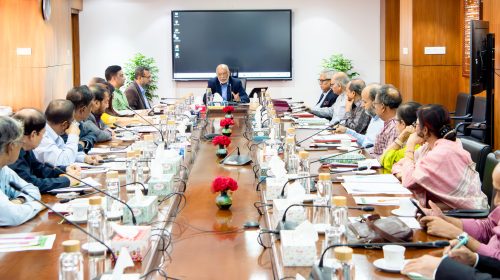
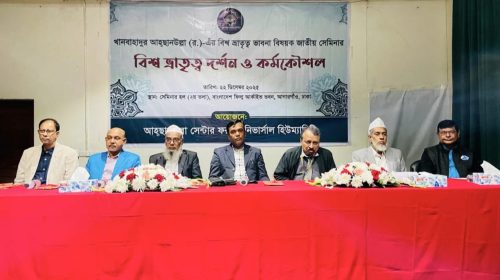
These remarks were made by the Dhaka Divisional Commissioner, Sharif Uddin Ahmed Chowdhury, while joining virtually as the chief guest at the national seminar titled “Universal Brotherhood: Philosophy and Strategy”, organized by the Ahsanullah Center for Universal Humanity. The seminar was held on Monday (22 December) at 3:30 pm at the seminar hall of the Bangladesh Film Archive in Agargaon, Dhaka. He stated that sustainable development is not possible without the integration of the rule of law, human rights, and ethics. If a humane outlook and respect for citizens’ dignity can be ensured at every level of administration, trust between the state and society will be further strengthened.
The keynote paper at the seminar was presented by Dr. Kazi M. Ahsanur Rahman, Advisor of DAM Club 25. He stated that Khan Bahadur Ahsanullah’s concept of universal brotherhood emerged from his complete faith in the oneness of the Creator, through which he regarded all creation as part of a single family. He emphasized universal love and service without discrimination between human beings, and even between living and non-living entities. This philosophy was reflected in his ideas of “Service to Creation” and “Religion of Humanity.” He believed that love for both the Creator and the creation could establish peace and unity in the world, which formed the core of his philosophy and teachings.
The seminar was chaired by Professor Dr. Muhammad Mahmudur Rahman, Pro-Vice Chancellor of the International University of Business Agriculture and Technology (IUBAT). In his address, he said that through his life and work, Khan Bahadur Ahsanullah (R.) emphasized both personal and social development, focusing on education, morality, rural development, and self-improvement through closeness to the Creator. He highlighted the integration of fear, reverence, and love in shaping one’s character and called upon the youth to adopt Ahsanullah’s life and ideals as their guiding path.
The seminar was moderated by Rakhi Ganguly, Senior Psychologist of the Health Sector of Dhaka Ahsania Mission. Panel discussions on Khan Bahadur Ahsanullah’s philosophy of universal brotherhood were delivered by Alhaj A. F. M. Enamul Haque, Director General of Khan Bahadur Ahsanullah Institute; Brother Victor Bikash D’Rozario, Vice Principal of St. Joseph International School; Professor Abdur Razzak, Head of the Department of Social Work at Mohammadpur Central College; and Professor Dr. Milton Kumar Deb, Department of History, University of Dhaka. An open discussion was conducted by Iqbal Masud, Chief Executive Officer of the Ahsanullah Center for Universal Humanity.
The speakers stated that through his thoughts and actions, Khan Bahadur Ahsanullah (R.) sought to build an enlightened society and never promoted fanaticism. The core message of his social philosophy was “Worship of the Creator and Service to Creation.” He believed that true worship of the Creator is not possible without first serving creation. He emphasized shaping oneself through the harmony of fear, reverence, and love. They further noted that if the vast richness, grandeur, and beauty reflected at every stage of his life could be properly analyzed, many unknown chapters of history might be uncovered. Although many historical truths of his life remain unresolved, our debt and reverence toward his colorful and profound life journey are immeasurable.