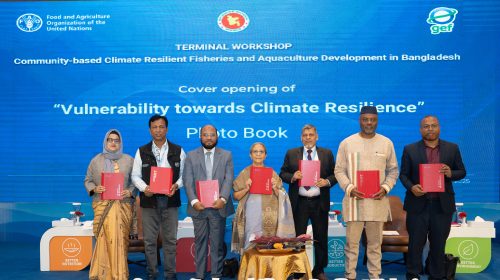



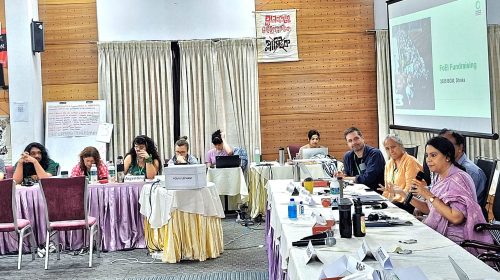


Bangladesh has marked the completion of a major national effort to strengthen climate resilience in coastal fisheries and aquaculture, with officials, community leaders and development partners highlighting the initiative as a turning point for households most exposed to climate change. The five-year ‘Community-based Climate Resilient Fisheries and Aquaculture Development in Bangladesh’ project- funded by the Global Environment Facility (GEF) and implemented by the Food and Agriculture Organization of the United Nations (FAO) in collaboration with the Department of Fisheries- concluded on Wednesday at a closing workshop held at the Hotel Intercontinental in Dhaka.
The initiative focused on some of the country’s most climate-vulnerable coastal upazilas, where rising temperatures, salinity intrusion, cyclones and unpredictable weather patterns threaten both aquatic ecosystems and the livelihoods of many. Throughout its implementation, the project conducted extensive climate risk assessment and introduced climate-smart aquaculture technologies designed to help farmers and fishers adapt to changing environmental conditions. Community-based resource management system was strengthened to ensure that adaptation efforts would continue beyond the project’s lifespan, supported by improved early-warning systems that allow families to anticipate and respond to climate shocks more effectively.
A main achievement of the project has been its capability to reach and empower large numbers of people. Support was extended to 127 Community-Based Organizations (CBOs), which now serve as platforms for collective decision-making and resource management. Thousands of fishing and aquaculture-dependent households received training on climate variability, disaster preparedness and sustainable aquatic resource practices. This widespread engagement helped communities shift from reactive coping strategies to proactive adaptation, embedding resilience into day-to-day livelihood activities.
The project’s outcome is reflected in measurable improvement in both financial stability and food production. Many households involved in the project reported substantial increases in income and a significant proportion saw clear improvement in fish production as a result of adopting the climate-resilient practices introduced through the initiative. This gain represents more than short-term development achievement; they indicate deeper, long-lasting resilience that allows families to plan for the future, diversify their livelihood and reduce vulnerability to environmental hazards.
Speaking at the event, Farida Akhter, Adviser to the Ministry of Fisheries and Livestock, underscored how the initiative demonstrated the power of collaboration and community-driven innovation. She emphasised that the improvement recorded- especially the strong rise in earnings and fish output among participating households- reflect real progress in strengthening food security and financial stability in climate-exposed regions. These outcomes, she said, show how well-designed intervention may uplift entire communities while reinforcing national commitment to climate adaptation.
FAO Representative in Bangladesh Valantine Achancho highlighted the value of locally grounded adaptation strategies, explaining that the project’s success stemmed from its focus on equipping households with the knowledge and tools needed to navigate increasing climate uncertainty. Through training, hands-on demonstration and practical guidance, the project empowered families who depend on natural water bodies, enabling them to take informed action to safeguard their livelihoods and respond to changing conditions.
Director General of the Department of Fisheries, Dr Md Abdur Rouf, described the initiative as transformative, saying that the combined effect of improved aquaculture practices, stronger early-warning capacities, community-based management and climate-smart technologies has significantly enhanced the resilience of vulnerable fishing communities. He emphasised that these approaches now serve as a powerful model for protecting livelihoods and promoting sustainable food systems in an era of intensifying climate impacts.
The closing event also set the stage for future expansion of climate-resilient fisheries and aquaculture initiatives across the country. FAO reaffirmed its commitment to scaling up proven models, strengthening local institutions and promoting sustainable production systems aligned with its vision of better production, better nutrition, a better environment and a better life for all, ensuring that no community is left behind.