




Syeda Rizwana Hasan, Advisor to the Ministry of Environment, Forest and Climate Change and the Ministry of Water Resources, has said that Bangladesh is carrying out administrative and legal reforms, but meaningful transformation will require time, sustained effort, and political continuity.
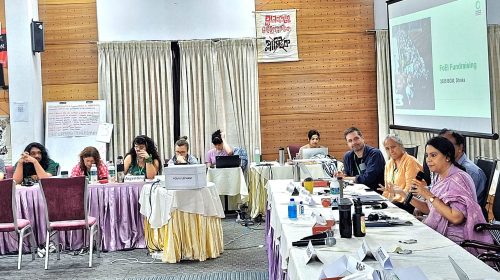
She made these remarks today while speaking at the Biennial General Meeting of Friends of the Earth International, held at BRAC CDM, Savar.
“We are working to reform both administration and the legal system. But when a country ranks 179 out of 180 in environmental performance, it does not rise to 50th place in a single year. That does not happen overnight,” she stated. She added that if Bangladesh remains persistent for five to seven years and moves even to around 73rd position, it would then be easier for an elected government to take the process further.
The Advisor noted that the present administration inherited a near-collapsed system—one that was neither responsive nor functioning. “Our first challenge was to make it minimally functional, and then initiate change. We have only begun that journey and are far from completion. But crucial steps have been taken, and these must continue beyond this interim period,” she said.
Speaking on accountability, she stressed that ensuring justice for victims of political violence is an immediate priority. She further said that the upcoming election is central to this transition. “The election will be held in February. We are confident that people from all walks of life will participate,” she noted.
Referring to recent legislative progress, she highlighted the passage of two important laws on forests. These laws prohibit further intervention in natural forests and recognise forest-dependent communities as custodians of ecosystems. “We also expect to pass a wetland protection law soon,” she added.
Drawing attention to current environmental realities, the Advisor said that Savar—where the meeting is being held—has been officially declared a degraded zone. “Bangladesh has long remained at the top of global rankings on air pollution. This cannot be reversed in a year, yet corrective processes have already started,” she said, adding that degraded zones are being targeted for restoration.
She informed participants that brick manufacturing units responsible for pollution in the area are being relocated after completion of legal and administrative procedures. “Workers will not lose employment; they will shift to agriculture-linked work at designated sites,” she assured.
The Advisor concluded by noting that Bangladesh is no longer at the bottom of environmental performance indices, largely because urban conditions have improved and government systems are operating with greater transparency. “Communication between government and citizens has increased, access to information has expanded, and there is now broader participation and freedom of expression,” she said.
A total of 85 delegates from 62 countries are participating in the eleven-day international conference.