


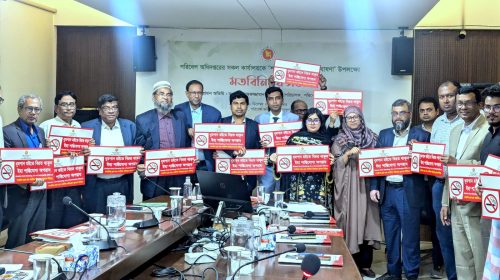


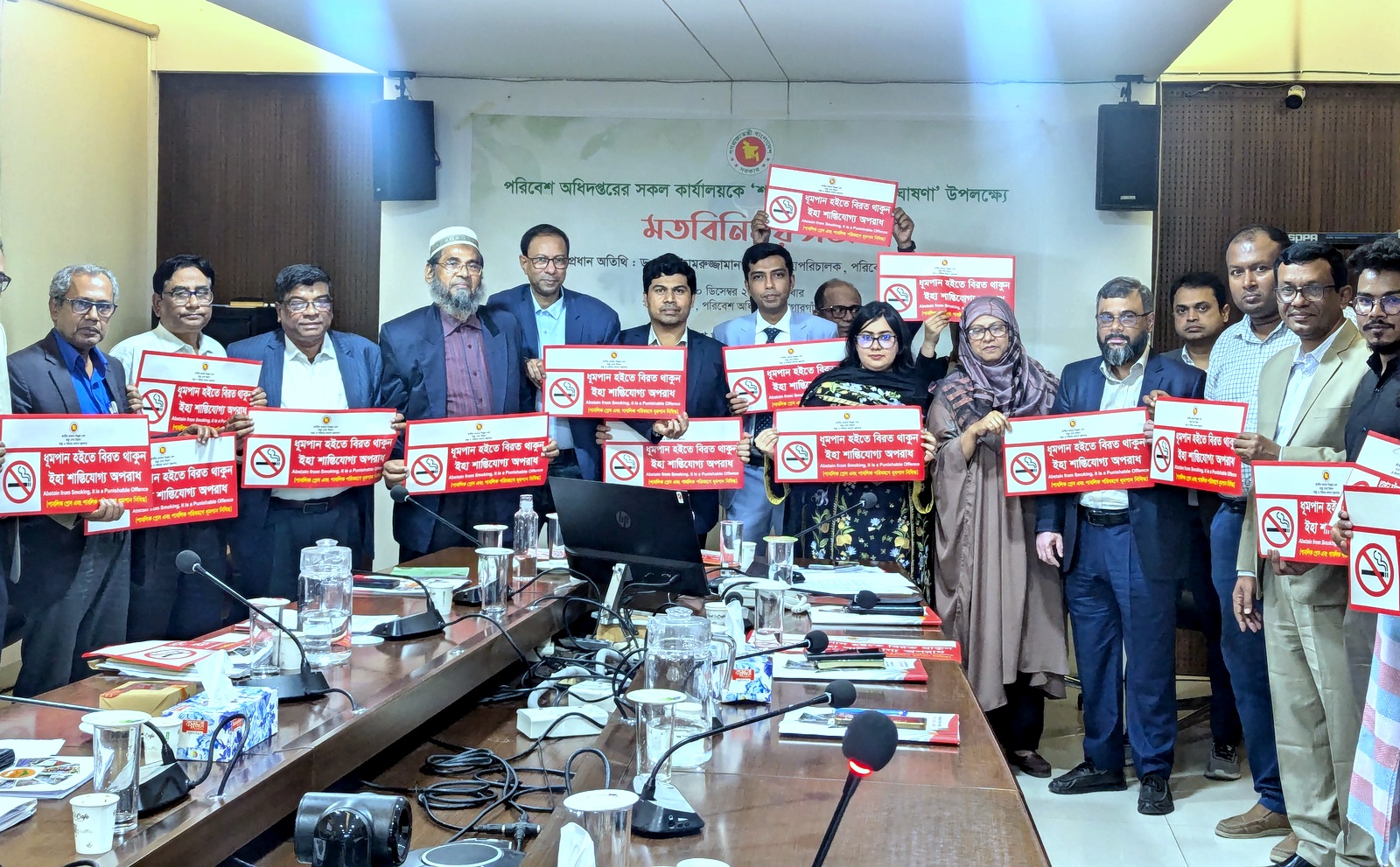
To protect non-smokers from the harmful effects of secondhand smoke, the Department of Environment and all its subordinate offices have been declared 100% smoke-free. From now on, all activities of the department will be conducted by following the national guidelines on tobacco control and maintaining a smoke-free environment.
On Wednesday (10 December), at a joint event organized by Dhaka Ahsania Mission and the Department of Environment at the DoE office in the capital, The Director General of the department, Dr. Md. Kamruzzaman, NDC, made the announcement as the chief guest of the program titled “Declaration of All Offices of the Department of Environment as 100% Smoke-Free.”
He stated, “To protect officers, employees, and visitors at the Department of Environment from the harmful effects of secondhand smoke, we have decided to declare the department 100% smoke-free.”
The keynote presentation was delivered by Md. Shariful Islam, Coordinator of the Tobacco Control Project at Dhaka Ahsania Mission. He highlighted that tobacco smoke contains around 7,000 chemical substances, of which about 250 are harmful to human health and cause fatal diseases. Each year in Bangladesh, more than 130,000 people die due to tobacco use, and 42.7% of non-smoking men and women in indoor workplaces and 21.6% in government offices are exposed to health risks from secondhand smoke. He also pointed out the severe negative impact of smoking on the environment. Every year, 40,490 tonnes of toxic waste from cigarette butts and packets contribute to environmental pollution. In 2024 alone, 4,139 fire incidents were caused by burning bidi and cigarette ends.
In the welcome speech, Iqbal Masud, Director of Health & WASH Sector at Dhaka Ahsania Mission, said that nearly 37.8 million people in the country use tobacco products, of which 19.2 million smoke. Additionally, around 40 million non-smokers are exposed to secondhand smoke. Alongside adults, more than 61,000 children suffer from illnesses caused by secondhand smoke. Therefore, to protect everyone from the dangers of secondhand smoking, all public places must be maintained as completely smoke-free.
Speakers noted that although all government, semi-government, and autonomous institutions are designated as smoke-free public places under the “Smoking and Tobacco Products Usage (Control) Act, 2005 (Amended 2013),” the law still allows optional designated smoking areas or smoking zones. As a result, non-smokers are exposed to secondhand smoke through these designated areas and suffer from various health complications. To protect non-smokers from these dangers, speakers called for the urgent passage of the proposed amendments to the Tobacco Control Act—which include abolishing the provision for designated smoking areas in all public places.
The event was presided over by Parvez Chowdhury, Director of the Department of Environment, and moderated by Khadijatul Kubra. Among the discussants were Deputy Director of Health Sector, Dhaka Ahsania Mission, Mokhlesur Rahman; Coordinator of Ahsania Mission Youth Forum for Health and Wellbeing, Marziana Muntaha; and directors of various divisions of the Department of Environment.