






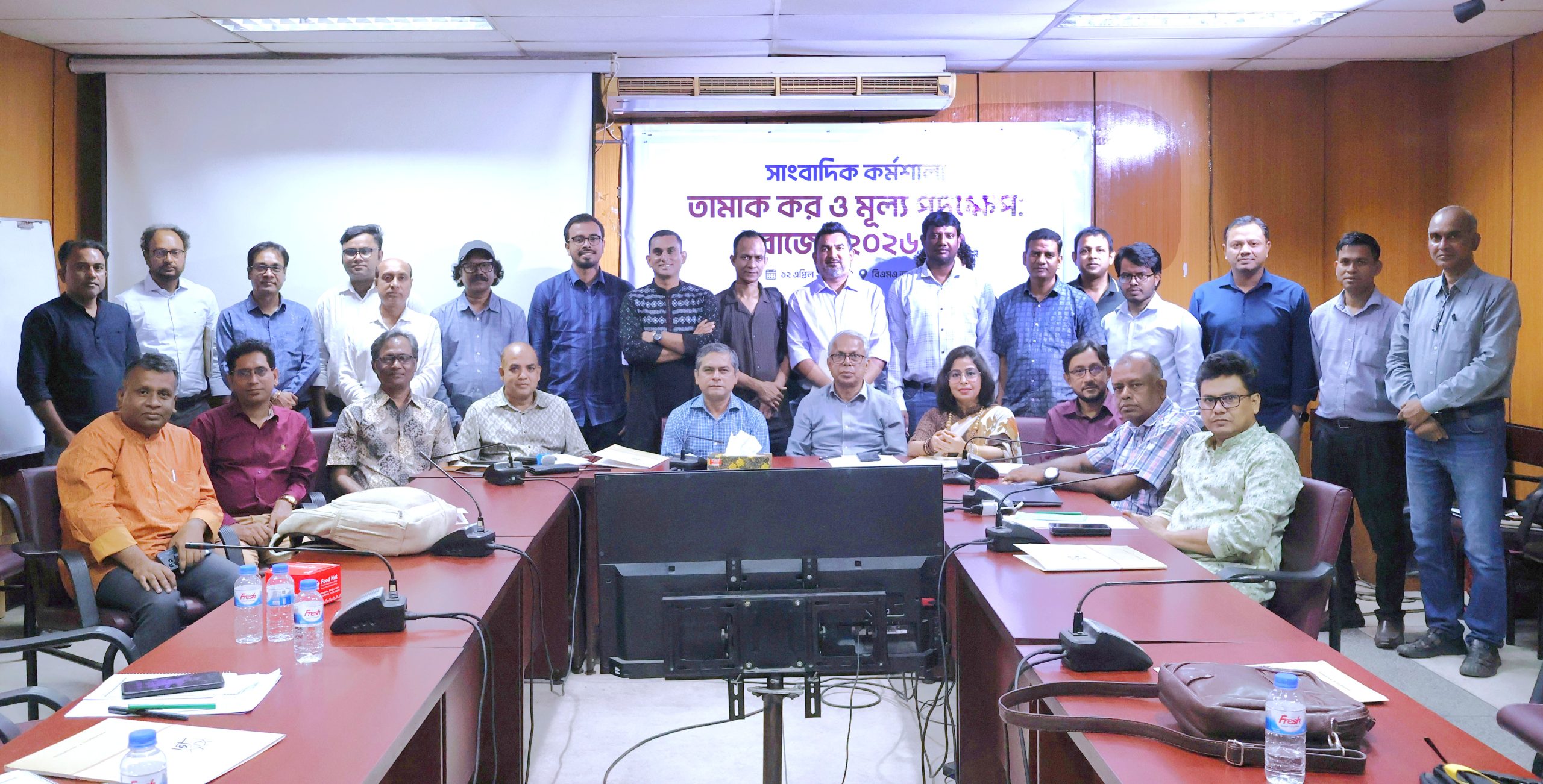
In the upcoming 2026-27 national budget, the government should reduce the number of cigarette price tiers, introduce specific tax system and hike the prices of all tobacco products. Experts made such suggestions today (12 April 2026, Sunday) during a journalists’ workshop titled “Tobacco Tax and Price Measures: Budget 2026-27” held at the BMA Bhaban in the capital. Adoption and implementation of anti-tobacco organizations’ proposals into the upcoming national budget would discourage tobacco use among the youth and the poor, reduce premature deaths and significantly increase revenue inflow. Organized jointly by research and advocacy organization PROGGA (Knowledge for Progress) and Anti-Tobacco Media Alliance (ATMA), the workshop was attended by 28 journalists from different print, television and online media outlets.
It was informed during the workshop that users of low and medium tier cigarettes, mostly the poor and working class, constitute the majority of total cigarette smokers. Merging the low and medium tiers into a single tier with a price hike would effectively encourage low income demographic to quit and discourage youth from getting hooked on tobacco addiction. In addition, introducing specific taxes would simplify the tobacco tax system and increase administrative advantages.
The proposals presented during the workshop for the FY 2026-27 national budget are as follows: The low and medium tier should be merged into one, and the price for 10 sticks of merged tier should be set at BDT 100. The retail price of high-tier cigarettes should be increased to BDT 150 from existing BDT 140 for 10 sticks. The prices for 10 sticks of premium cigarettes should be raised to BDT 200 from existing BDT 185. The supplementary duty (SD) on all cigarette tiers should remain at the existing 67 percent. Besides, the government should introduce BDT 4 per 10 sticks as a specific tax.
Experts also recommended that the government introduce uniform price and taxes for both filtered and non-filtered bidi and the retail price for 20 sticks of bidi should be BDT 30, followed by a 50 percent SD. Regarding smokeless tobacco, the retail price for 10 grams of jarda and gul should be raised to BDT 60 from existing BDT 48 and BDT 30 from existing BDT 25, followed by 60 percent SD. Experts also recommend imposing specific taxes on bidi, jarda and gul at a rate fixed by the National Board of Revenue (NBR). The budget proposals also suggest retaining 15 percent VAT on the retail prices of tobacco products and continuing the existing 1 percent health development surcharge (HDS).
In support of the proposals, speakers informed that budget proposals for FY 2026-27 placed by anti-tobacco organizations, if realized, can generate more than BDT 85 thousand crore in tobacco tax revenue, representing an additional BDT 44 thousand crore compared with the current fiscal year. Implementation of such proposals, in the long run, will also help prevent the premature deaths of 370,000 Bangladeshis, including nearly 185,000 youths. It would also encourage nearly 500,000 adults to abstain from smoking and discourage around 372,000 youths from lighting up.
The discussants in the workshop include Mr. Sazzadur Rahman, Deputy Editor, The Business Standard; Mr. Mortuza Haider Liton, Convener, ATMA; Ms. Nadira Kiron and Mr. Mizan Chowdhury, both Co-convener, ATMA; Mr. Hasan Shahriar, Head of Programs, PROGGA and Mr. ABM Zubair, Executive Director, PROGGA.