ঢাকারবিবার , ২৫ অক্টোবর ২০২৬
Public health and economic experts have called on the government to significantly strengthen tobacco taxation in the upcoming FY2026-27 national budget, arguing that higher taxes could both increase state revenue and reduce tobacco consumption across Bangladesh.
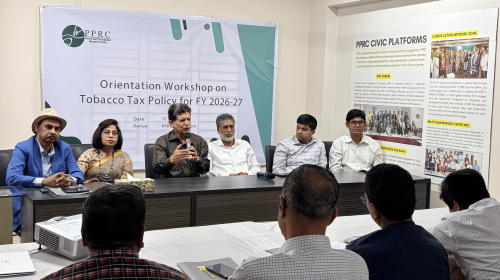
The recommendations were presented during an orientation workshop on tobacco product pricing and taxation held at the Power and Participation Research Centre (PPRC) in Dhaka. The event aimed to brief journalists and tobacco control advocates on the rationale and methodology behind a proposed reform of the country’s tobacco tax structure.
The proposal was developed jointly by Economics for Health, the World Health Organisation (WHO), Campaign for Tobacco-Free Kids (CTFK), Vital Strategies, and the Institute of Health Economics (IHE) at the University of Dhaka as part of broader efforts to strengthen tobacco control and improve revenue mobilisation.
Dr. Shafiun N. Shimul, Professor and Director of the Institute of Health Economics (IHE), presented the technical analysis during the workshop. He explained that tobacco products in Bangladesh remain highly affordable compared with neighbouring countries, which contributes to persistently high consumption.
According to modelling estimates presented at the session, the proposed tax reforms could generate around Tk 44,000 crore in additional government revenue compared with the previous fiscal year. Experts noted that such revenue could be redirected toward strengthening the country’s public health system.
Dr. Shimul also challenged a common misconception that increasing tobacco taxes reduces government income. Evidence from global and local studies, he said, consistently shows that higher tobacco taxes increase public revenue while discouraging consumption.
Public health benefits were another major focus of the proposal. The research estimates that the proposed price increases could prevent up to 400,000 adolescents from starting tobacco use, highlighting the long-term health impact of stronger taxation policies.
Studies indicate that about 90 percent of the tobacco market in Bangladesh is dominated by low- and medium-priced cigarettes, primarily because of their affordability. This pricing structure has helped maintain high consumption levels, placing a heavy burden on the healthcare system.
Experts estimate that tobacco-related healthcare costs in Bangladesh reach approximately Tk 87,000 crore each year, underscoring the economic strain caused by tobacco-related illnesses.
To address the issue, the proposal recommends merging the existing low and medium cigarette price tiers and introducing a unified minimum retail price of Tk 100 for a 10-stick pack.
In addition, researchers suggest introducing a specific excise tax of Tk 4 per 10-stick pack, which would apply uniformly across all cigarette price categories.
Policy experts believe this simplified tax structure would make tobacco products less affordable while improving tax collection efficiency.
Some workshop participants raised concerns about the potential impact of higher tobacco taxes on domestic tobacco companies and their workers.
Responding to these concerns, Dr. Shimul said the proposed structure was carefully calibrated using historical data and industry trends. He noted that the reform focuses primarily on reducing excess profitability in the tobacco industry while protecting broader economic stability.
Dr. Hossain Zillur Rahman, Executive Chairman of PPRC, described tobacco control as an important democratic policy issue.
“Tobacco control is fundamentally a democratic policy exercise,” he said. “It is not about banning individuals or punishing smokers, but about using policy tools such as taxation, sales regulation and advertising restrictions to protect public welfare.”
He added that tobacco regulation represents a broader policy choice between commercial interests and public health priorities, urging policymakers to prioritise the long-term wellbeing of citizens.
Dr. Rahman also emphasised that government revenue systems evolve over time and should not depend heavily on a single sector such as tobacco.
He noted that economic activity can gradually shift toward more productive and sustainable industries, reducing reliance on harmful products while maintaining fiscal stability.
Participants at the workshop stressed that stronger tobacco taxation could play a key role in addressing Bangladesh’s current challenges in meeting national revenue targets.
They also highlighted the importance of continued collaboration among researchers, policymakers, journalists and civil society organisations to ensure effective implementation of tobacco tax reforms.
Experts concluded that stronger tobacco taxes represent one of the most evidence-based policy tools available to both increase government revenue and reduce the country’s tobacco-related health burden.