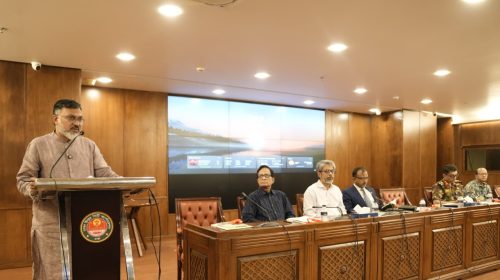


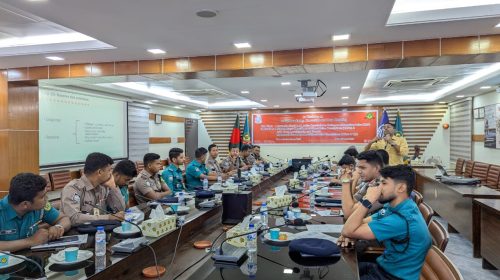






The ‘Road Safety Situation in Dhaka” report was officially launched yesterday at the Dhaka North City Corporation (DNCC) auditorium by DNCC Administrator Md. Safiqul Islam Khan. DNCC Chief Executive Officer Mohamad Ashaduz Zaman and Chief Engineer Brigadier General Syed Raquibul Hasan, PSC were present at the event.
The report was developed under the Bloomberg Philanthropies Initiative for Global Road Safety (BIGRS), a global road safety program that spans across 15 countries of the world. Vital strategies, an international organization and a partner of this consortium, has provided technical support in this endeavour. This report has been produced by analysing the merged dataset of 2022-2023 crash data created from the First Information Reports (FIR) and General Diary (GD) recorded at the Police Stations and data from the MAAP5 Database of Dhaka Metropolitan Police (DMP). This report has been jointly published by DNCC and DMP.
The event, moderated by BIGRS Coordinator Md. Abdul Wadud, featured remarks from Khalid Mahmud, Program Manager of BRAC Road Safety Program; Aminul Islam Sujon, Technical Advisor at Vital Strategies; and Engineer Khondaker Mahbub Alam, Additional Chief Engineer, DNCC, among others.
Dr. Tanvir Ibn Ali, Surveillance Coordinator – BIGRS Dhaka North, presented the key findings from the report. According to the crash data, 540 people were killed on Dhaka Roads between 2022 and 2023. Among the deaths, 56% (303) were pedestrians, 24% (128) were motorcyclists, and 8% (41) were rickshaw occupants. This signifies pedestrians and motorcyclists as the two most vulnerable road users in Dhaka. Around 81% victims of these fatal crashes were male. Most deaths were distributed among the individuals aged 20-49 indicating untimely demise of people at their most productive years because of fatal crashes. Fatalities were higher at night than during the day. Buses and Trucks were the deadliest impacting vehicles, killer of the most crash victims. This report identified several high-risk locations and corridors across Dhaka city. During the study period, Airport and Jatrabari intersections recorded 12 deaths while Abdullapur intersection recorded 10 deaths. Notably, an 8 km long corridor on Dhaka-Mymensingh Highway, from the Army Golf Club Bus stop the Abdullahpur Bus stop observed a staggering 67 deaths – more than 8 deaths per km. Dr. Tanvir recommended the need for coordinated action to ensure safety for the pedestrians and motorcyclists.
DNCC Administrator, Md. Safiul Islam Khan noted that pedestrians and motorcyclists were the most victims of fatal crashes. He highlighted, even though less road users move during the night hours, the absence of traffic congestion give rise to excessive speeding leading to higher fatalities at night.
He further stated that encroachment or obstruction on footpaths force pedestrians onto the roads. These increases the risk of being hit by a moving vehicle. He called for public cooperation to make footpaths walkable again freeing them from illegal encroachment. He pointed out that crossing also leads to pedestrian hit collisions. Mr. Khan urged the pedestrians to avoid unsafe crossing and instead use designated areas such as zebra crossing and foot overbridges for safer crossing of the streets.
The Administrator, added that the high-risk locations identified in the report will be redesigned in coordination with the World Resource Institute (WRI) to enhance safety.
DNCC CEO Mohamad Ashaduz Zaman maintained that collective, coordinated action from all relevant actors is a prerequisite for ensuring road safety in the Dhaka city. He emphasized that greater awareness and compliance with traffic laws and regulations among all road users, namely pedestrians, passengers and drivers, can bring about significant shift in the safety situations on Dhaka roads.
Chief Engineer Brigadier General Syed Raquibul Hasan stressed the instrumental role of data-driven decision making which enables the most effective implementation of road safety measures. He noted that the identified high-risk intersections and corridors will undergo redesigns to reduce the unwanted untimely deaths. Planned interventions will include safer crossings facilities, improved wider footpaths and better zebra crossings.
BIGRS Initiative Coordinator Md. Abdul Wadud stressed the need for infrastructure improvements and effective enforcement of road transport laws at high-risk locations to enhance safety for pedestrians and motorcyclists. Mr. Wadud noted the ongoing efforts by DNCC and DMP to remove illegal encroachments of footpaths to as a step towards ensuring safer mobility of the pedestrians.
Khalid Mahmud, program manager of BRAC road safety program reiterated the necessity of the implementation of Road Transport Law 2018, Road Transport Rules 2022, Standard Helmet Use Guideline and the Speed Management Guidelines.
The Additional Chief Engineer of DNCC, Khondoker Mahbub Alam mentioned that several intersections, crossings, U-loops, and school zones have already been improved to enhance road safety with further works ongoing to ensure pedestrian-friendly infrastructures.
Aminul Islam Sujon of Vital Strategies remarked that road crash deaths are not just statistics but represent profound and lasting loss for families. He underscored the importance of mass awareness campaigns.
Among others, Md. Mamunur Rahman, Senior Road Safety Specialist at Dhaka Transport Coordination Authority (DTCA); Major Md. Nizam Uddin, General Manager (Operations), Bangladesh Road Transport Corporation (BRTC); SM Azad Hossain, Vice President of Nirapad Sarak Chai (NISCHA); Farzana Islam Toma, Consultant at the World Resources Institute (WRI); Md. Bazlur Rahman, Associate Professor at Dhaka International University; and Kazi Burhan Uddin, Programme Manager at the Centre for Injury Prevention and Research, Bangladesh (CIPRB), participated in the discussion and delivered remarks.
Also Dr. Watinn Alam, National Professional Officer (NPO) for Injury Prevention & Health Promotion at the World Health Organization (WHO) Bangladesh; Mohammad Wali Noman, Programme Manager at the National Heart Foundation Hospital and Research Institute; Tarikul Islam, Communication Officer at Dhaka Ahsania Mission; Tanvir Ahmed, Deputy Commissioner of Police (Gulshan), Dhaka Metropolitan Police (DMP); Mohammad Mizanur Rahman, Deputy Commissioner of Police (Traffic, Gulshan Zone); Moshtaque Sarker, Deputy Commissioner of Police (Traffic, Mirpur Zone); and Md. Ruhul Haque, Additional Deputy Commissioner of Police, Uttara Traffic Zone, were present.
In addition, representatives from the Roads and Highways Department (RHD), along with officials from government, non-government, national, and international organizations, as well as engineers, urban planners, and law enforcement agencies, participated in the event.
The event stressed the importance of credible data management for better policy and enforcement of those polices are in place.