Rather than for people, our roads have been designed to incentivize cars and motor vehicles to drive at high speeds across the country, and the results are fatally predictable. With over 30,000 dying every year. Now, because of the speed limit guidelines passed last year, Bangladesh has speed limit regulations that are in line with World Health Organization best practices. At the expressways and highways, 80 kilometres per hour is the maximum speed, and 30 kilometres per hour in urban roads and around schools.
The details of the new official Bangladeshi speed limits are given below:
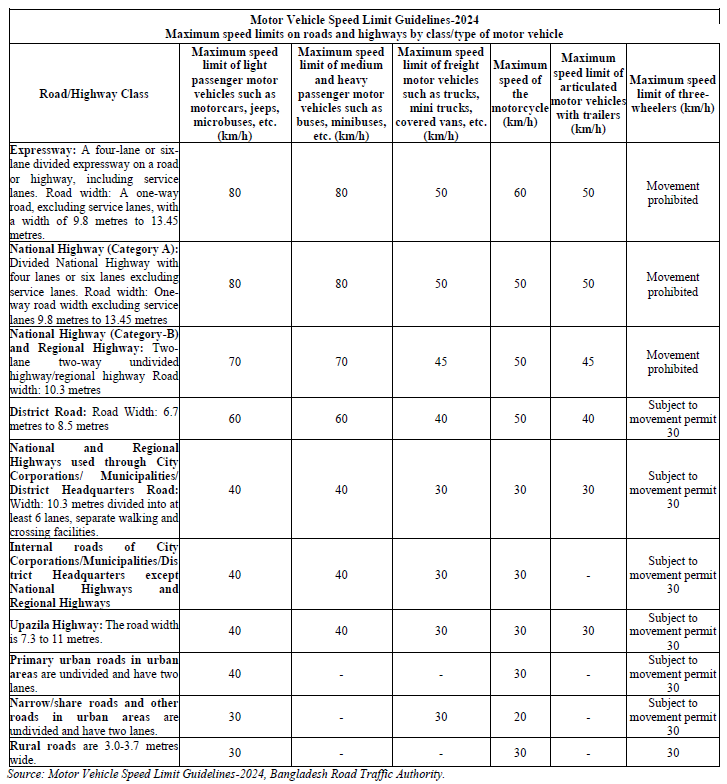
Unfortunately, the design code titled “Geometric Design Standard Manual 2005” of the Roads and Highways Department for the roads in Bangladesh remains unchanged, which is dangerous. The existing road design code is not aligned with the new best practice speed limit. Roads are being built for a deadly speed of 100kmph or more, when the maximum speed in the country is 80kmph! Thousands will die as a result. We need change.
The relevant authorities of the government of Bangladesh should take necessary measures to amend the road design code towards saving lives in the future. In order to make the road design code safer, six priority areas have been identified.
- Reduce design speed from a maximum of 100kmph down to 80kmph: Bangladesh made great progress with its internationally recognized best practices speed limits. Now, the road design code needs to be aligned with the new speed limits, so that roads are not built to incentivize driving faster than the speed limits. As a start, the maximum design speed needs to be reduced from 100kmph to 80kmph as under no circumstances should people be driving above the lifesaving legal limit. In tandem, all design elements such as raised crosswalks, lane widths and road widths should be revised to reflect the 80 kmph maximum.
- Reduce standard lane/road widths: In the interest of saving lives, countries around the world are narrowing lanes and roads. Narrow lanes and road widths lead people to drive slower, and also narrow the crossing distance and thereby reduce the risk of a fatal crash. To save lives, the government should reduce the national lane width minimum from a dangerous 3.65 metres to a maximum of 3.5 metres. This change is by no means extreme, as some countries such as Spain, the Netherlands, and Switzerland use 3.5-metre lanes for speeds up to 120 km/h – but it would definitely save lives. What’s more – it would save money, as narrower roads cost less to build.
- Replace accident with crash: Evidence is clear that by changing the words we use to describe road collisions from accidents to crashes, we can increase the likelihood that citizens will support government action to make the roads safer. People hear and read the word “accident” and think “unavoidable.” Researchers have found that this in turn leads to less support for important government action to prevent injuries. In order to be aligned with global best practices, the government should remove the word “accident” in all locations in the manual and replace it with “crash.”
- Delete 85th percentile rule: Speeds should be set for a given stretch of road according to the needs of the community living there, and even more so, for safety. The 85th percentile rule is determined by the fastest 15 percent of vehicles. That means that if every five years you measure the speeds, reset the limit, and then redesign the road to accommodate the new faster speed, you will have ever-increasing speeds over time and dramatic declines in safety. In order to save lives, the government should remove all references to the 85th percentile rule. This rule can be replaced by a classification system based on land use or function.
- Delete Level Of Service (LoS) or Replace it with Vehicle Kilometres Travelled reduction targets: It’s time to eliminate Level of Service (LoS), which makes transport planning about making cars go faster at the expense of nearly everything else. This concept has been shown to lead to deadly consequences. As one expert notes, “because Level of Service only rewards the movement of motor vehicles, it promotes dangerous, high-speed streets and sprawling land use.” If a replacement is needed, authorities should replace it with Vehicle Kilometres Travelled, which measures how much driving happens overall, as is being done by many cities around the world to create less car-dependent transport systems.
- Protect children with minimum 8-centimetre raised crosswalks at all schools: Mandatory design standards should be established for sensitive zones like schools, markets and hospitals. At the moment, the standard manual has no elements that protect children. This should change. In order to save the lives of children and those who care for them, the government should require at least one 8 centimetre minimum raised cross walk in front of every school entrance. The safety effectiveness of these kinds of raised crosswalks at schools has been demonstrated with success in other cities such as Ho Chi Minh City.
These changes in the road design code will be instrumental to ensure the safety of pedestrians, public transport users, cyclists, rickshaw passengers and drivers, two-wheeler passengers and drivers, as well as passengers and drivers in cars. The time to act is now. By reforming the road design code, the government can create safer, more equitable streets that protect every user and finally put people before vehicles.
Authors: Farzana Islam Toma is Consultant at the World Resources Institute, Rezaur Rahman is Highway Design & Road Safety Expert and Sutapa Tasnim is urban planner.