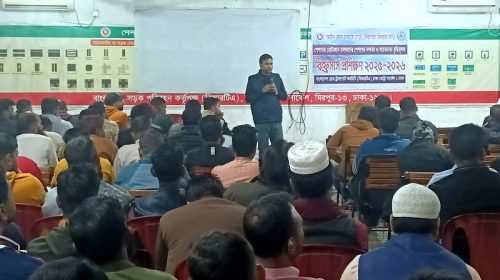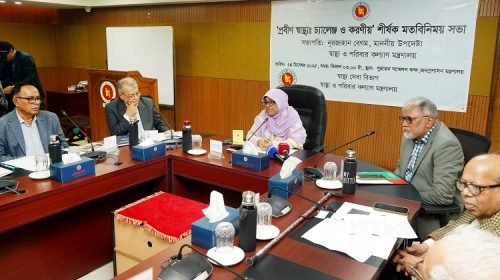









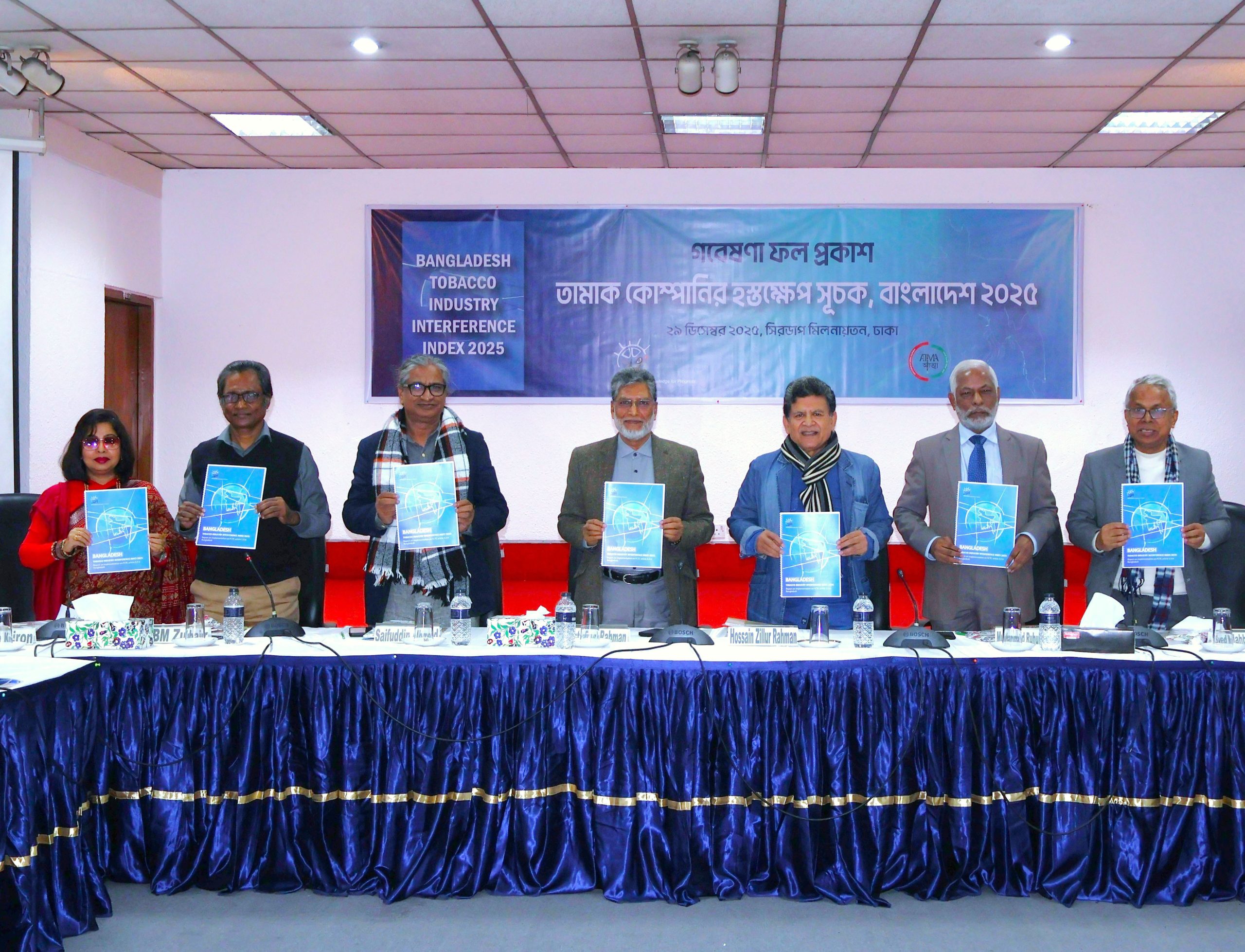
Bangladesh continues to experience a high level of tobacco industry (TI) interference in its policy arena. The Global Tobacco Industry Interference Index 2025 ranks Bangladesh among the countries with the highest level of TI interference. The country, in fact, records the highest degree of such interference in all of Asia. The majority of the incidents of TI interference were aimed at the amendment process of the tobacco control law, initiated by the Ministry of Health and Family Welfare (MoHFW). Such research finding was unveiled today (29 December 2025, Monday) in an event organized jointly by research and advocacy organization PROGGA (Knowledge for Progress) and Anti-Tobacco Media Alliance (ATMA).
In the 2025 Index, Bangladesh scored 69 out of 100. The lower the score, the better the compliance with Article 5.3. The study covered a total of 100 countries, in which Bangladesh ranked 66th. Nepal, India, Pakistan, Sri Lanka, and the Maldives ranked 43rd, 59th, 54th, 45th, and 39th respectively. Brunei performed the best (1st, score 14), while the Dominican Republic performed the worst (100th, score 98).
The research for Bangladesh country report, as a part of the Global Industry Interference Index, has been undertaken by PROGGA (Knowledge for Progress). The current report is based on information available in the public domain of incidents that took place between April 2023 to March 2025. The study assesses how the government addressed and responded to the tobacco industry’s interference by using the FCTC Article 5.3 Guidelines. The higher the score, the larger the extent of interference it suggests. Funded by Bloomberg Philanthropies, the study also received support from Southeast Asia Tobacco Control Alliance (SEATCA) and Global Centre for Good Governance in Tobacco Control (GGTC). PROGGA has been releasing Bangladesh country reports since 2018.
According to the study findings, Bangladesh adopted the FCTC Article 5.3 Guidelines in 2008. However, although two decades have passed since, the country is yet to formulate and implement a code of conduct in line with FCTC Article 5.3 for government offices. As a result, the tobacco industry continues to interfere in the amendment of tobacco control law, maintains unnecessary interaction with policymakers, uplifts brand image through CSR programs, and enjoys financial and other benefits.
It was unveiled that tobacco industry has been persistently lobbying, conducting so-called research work, holding roundtable discussions and press conferences, organizing media campaigns as well as online petition campaigns, uplifting brand images through CSR campaigns, and a wide variety of ill tactics. The government has been found to be particularly lethargic in disclosing interactions with the tobacco industry. The government’s share in a multinational tobacco company and the presence of former and current government employees in the company’s Board of Directors amount to grave conflict of interest for our policymakers.
The study recommends that the government formulate and implement code of conduct in line with FCTC Article 5.3 for all government bodies; finalize the Smoking and Tobacco Products (Usage Control) (Amendment) Ordinance, 2025; bar the entry of new foreign and local tobacco companies and related investment into Bangladesh; and deny the establishment of new tobacco related factories in the country’s Special Economic Zones (SEZs) and Export Processing Zones (EPZs). The study also urges policymakers to exclude cigarettes from the list of essential commodities by amending the Essential Commodity Act 1956; divest investment from tobacco companies; and formulate as well as implement a simple tobacco price and tax policy in line with the WHO FCTC Article 6 to reduce the demand for tobacco.
In his speech as the chief guest of the event, Dr. Hossain Zillur Rahman, former caretaker government adviser and prominent economist, said, ” The amendment ordinance of the Tobacco Control Law has received final approval from the Advisory Council, which is very good news. Now, the ordinance must be published in the Gazette as soon as possible. We do not want to see any further interference at this stage.”
Among the discussants of the event were Dr. Mary Assunta, Head of Global Research and Advocacy, Global Center for Good Governance in Tobacco Control (GGTC); Md. Mostafizur Rahman, former Chairman of BCIC; Md. Ruhul Quddus, former Coordinator of the National Tobacco Control Cell (NTCC); Saifuddin Ahmed, Executive Director of WBB Trust; Syed Mahbubul Alam, Senior Technical Advisor, Vital Strategies; Mortuza Haider Liton, Convenor, ATMA; and ABM Zubair, Executive Director, PROGGA. The event was hosted by Nadira Kiron, co-convener, ATMA whereas Md. Hasan Shahriar, Head of Programs, presented key findings. Representatives from a number of anti-tobacco organizations and civil society leaders also attended the event.