ঢাকাশুক্রবার , ২৩ অক্টোবর ২০২৬
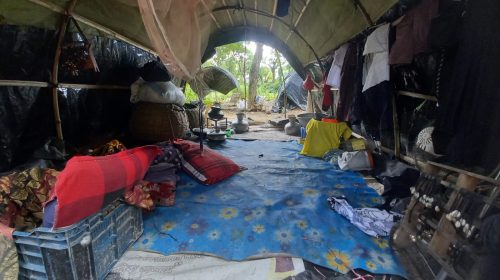
Jaygun Bibi is now 68 years old. She spends most of her day sitting in a chair. When she feels restless, she sometimes strolls around her temporary hut. Occasionally, she looks after her daughter’s grandchildren. Due to the burden of age and various health issues, she can no longer earn like other women. While the other women spend their days walking from village to village, treating the sick and performing spiritual rituals to ward off misfortunes, Jaygun Bibi sits alone in the tent of her entire Bede (nomadic) group. By quietly sitting near the tent, she seems to be making a quiet statement that there is still a woman among them.
Jaygun was born on a boat. Her parents and even her grandparents were also born on a boat drifting along a swift-flowing river. For hundreds of years, boats were their only means of shelter and transportation. As landless people living communally on boats, they are often referred to as the “water gypsies.” However, in Bangladesh, they are known as the marginalized nomadic Bede community. Locally, the Bedes are also referred to as Badiya, Baiddya, or Boidyany.

Jaygun Bibi
The Bede community is primarily matriarchal. Though they are followers of Islam, their practices are largely influenced by Hindu traditions. They worship the serpent goddess Manasa, observe rituals for deities like Mongolchondi and Shashti, and even bow in reverence to goddesses Kali and Durga. This unique nomadic community, despite identifying as Muslim, does not marry outside their own group or into any other community.
In the past, each Bede family had its own boat. A group would be formed with 10/15 boats, and multiple groups together made up a fleet. Each Bede fleet had a leader, known as the Sardar. The Sardar was responsible for setting the rules of the fleet, determining the trade routes for each group, and assigning their respective areas.
Today, over time, groups are now formed with 10 to 15 families, each led by a Sardar. However, these groups no longer have boats. Although Jaygun Bibi, who was once born on a boat, lived her entire life centered around the river—her movement, cooking, and livelihood all revolved around it—many members of her current group have never even seen a boat. This is because climate change has caused most rivers in Bangladesh to dry up. As a result, they can no longer travel across the country by boat. For the sake of survival, they’ve had to abandon the rivers and move on land. This shift has also brought major changes to their livelihoods.
In the past, Bede men did not engage in any work. While the women went out to earn a living, the men stayed home to take care of the household and children. The women traveled from one region to another. Their traditional occupation involved practicing herbal medicine and selling natural remedies.
In addition, they performed spiritual healing rituals, applied cupping-like therapy using cow horns to draw blood for pain relief (known locally as shinga), provided dental treatment, showcased monkey performances, and practiced magic tricks. Snake catching and snake charming were also among their prominent professions.
But with the destruction of the country’s forests, monkeys and snakes have also become inaccessible to the Bedes. Recalling those earlier days, Jaygun Bibi said, “We finally left our boats in 2004. Most rivers in the country no longer have enough water for boats to travel. In stagnant or dried-up areas, the boats would quickly deteriorate, and we suffered heavy losses. Many times, we even got stranded in different places with our boats. Due to natural disasters, rising salinity, and sparse population in the rivers near the sea, we were forced to give up our boat-centered way of life.”
She also said that “My parents and grandparents used to sell herbal medicines and catch fish from the rivers. We sustained our family by selling those fish too. But now, the rivers themselves have disappeared, how can we find fish? People no longer seek traditional treatments from us like before. Even in local towns, modern hospitals are everywhere. At the slightest ailment, everyone rushes there. Now, even if we roam village to village all day, we can’t earn enough. When someone in the family suddenly falls ill, affording treatment becomes a struggle.”
As Jaygun Bibi spoke, two Bede youths 28-year-old Sabuj Mia and 32-year-old Shah Rukh Khan sat beside her, shaping clay marbles for bird hunting. With their wives away selling herbal medicine in nearby villages, the men were looking after the children. In their spare time, they also sell cowrie (traditional cowrie shells) and amulets in neighboring villages.
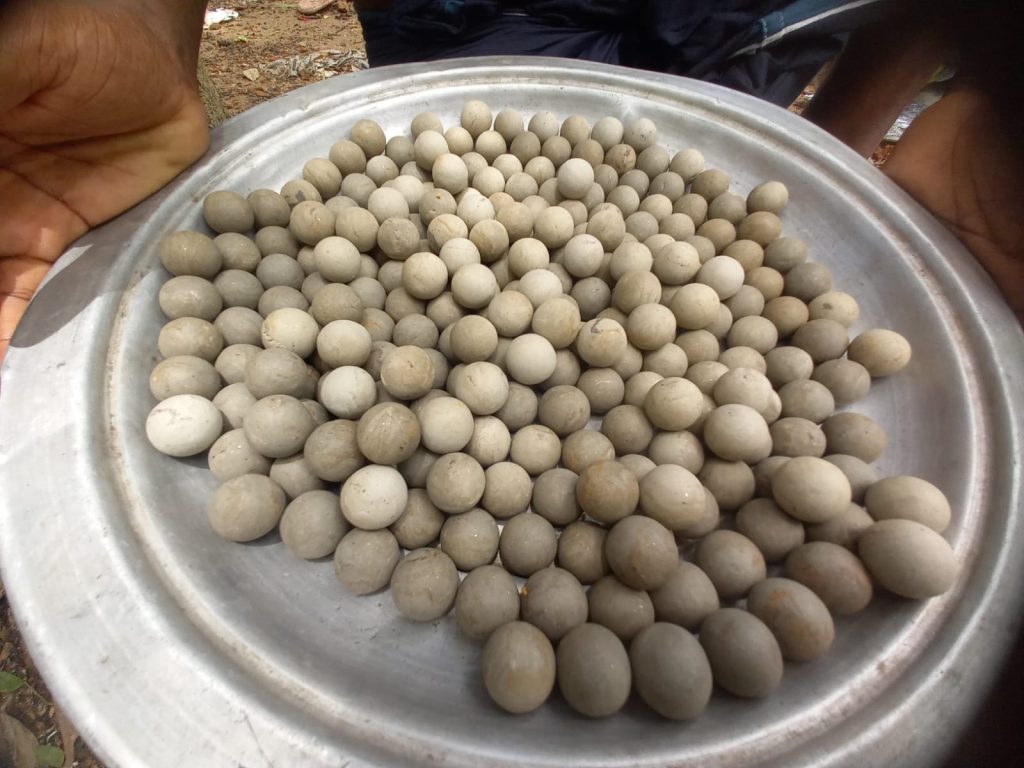
Clay marbles
Sabuj Mia said, “In our community, men didn’t use to earn a living. But now, since the women can no longer earn as they used to, we help them out. In the cities, most people are educated, so they no longer believe in cowrie, amulets, or herbal remedies. But in rural areas, people still have a lot of faith in traditional healing and herbal medicine. So we can earn a little by going village to village. Still, even that income isn’t enough to run a household. In the past, when my parents’ income dropped, they would catch fish from the river and sell them. But we’ve been deprived of that river-based life. Now, even collecting safe drinking water has become difficult.”
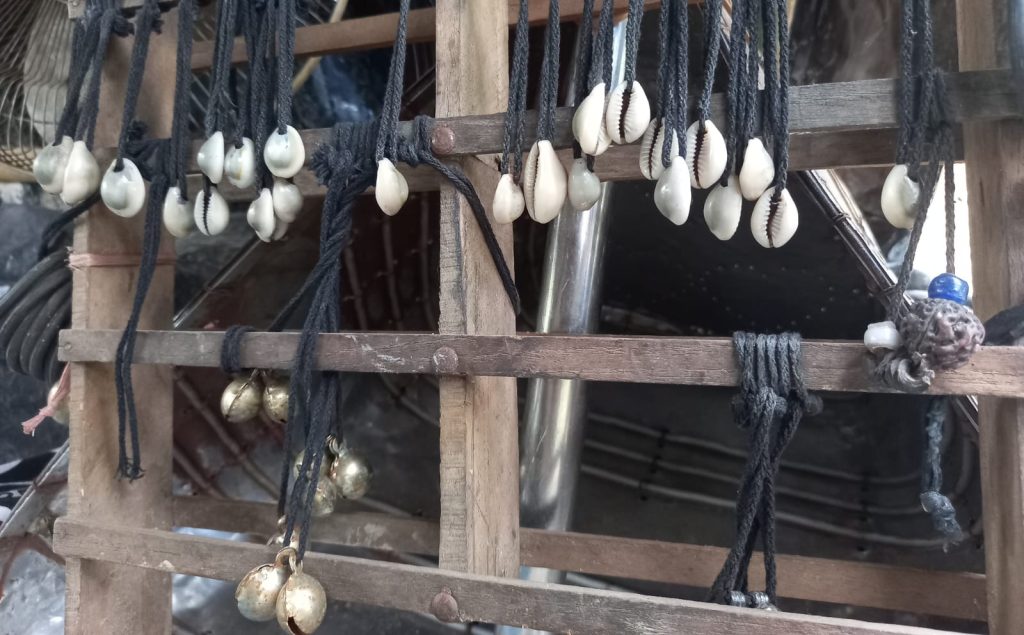
Cowrie, amulets
Due to their nomadic lifestyle, the Bede community remains excluded from most government welfare schemes in Bangladesh. Although they were granted voting rights in 2008, they still lack access to proper education and healthcare. Despite government provisions for free schooling, 90% of Bede people remain illiterate as their constant mobility prevents them from enrolling children in schools permanently.
According to the Department of Social Services, there are approximately 75,000 Bede people in Bangladesh.1 The Bedes claim that their first settlement was established in Bikrampur, located in the Munshiganj district near Dhaka. From there, they gradually spread across remote regions of Bangladesh, as well as into West Bengal and Assam in India. As a result, some members of the Bede community still reside permanently in those areas. Twice a year, they travel from those settlements across the country for six months at a time in search of livelihood. Those without permanent homes live in makeshift huts and move in small groups from one district to another.
Rajan Mia, the Sardar (leader) of a Bede group temporarily residing in Gabtoli, Dhaka, said, “Once, only women used to earn money by performing snake shows or practicing traditional healing. But now, even though both men and women roam villages from morning to evening without rest, they can no longer earn as they once did. On top of that, snakes are no longer available like before. The rivers around Dhaka have dried up. With the disappearance of rivers and water, the use of boats has also declined significantly. Since the roads are better, we are now forced to travel and live on land. Sudden floods and droughts have severely affected our lives and livelihoods. Housing shortages, lack of food and clean water, and the spread of various diseases have also led to a rise in premature deaths.”
With the collapse of their river-centered way of life, many Bede women are now resorting to begging in Dhaka city. Most Bede women living around the Dhaka area no longer sell traditional medicine. Occasionally, some are seen using a small snake to frighten passersby in order to forcibly collect money. On this topic, Rajan Mia says, “None of our women forcefully take money from anyone. Some may show a snake for entertainment and receive money in return. But how are these families supposed to survive? With the rivers drying up and no water left, many of us were forced to abandon boats and seek refuge in the city. Although our elders struggle to adapt to this new life, we have no other choice.”
A recent study by the research-based think tank Change Initiative revealed that over the past 44 years (1988 to 2024), land surface temperature in Dhaka has increased by 3 to 5 degrees Celsius. About 60% of Dhaka’s water bodies have disappeared. Only 4.8% of the city’s area now contains remaining water bodies. The city’s green coverage has dropped from 21.6% to just 11.6%. Moreover, there is currently no area in Dhaka where the temperature remains below 30 degrees Celsius.2 As a result, it’s easy to imagine how disoriented and displaced the Bede community, who traditionally lived in rivers and natural environments, must feel in this new reality.
Reference
Author: Ibrahim Khalil, journalist and researcher.